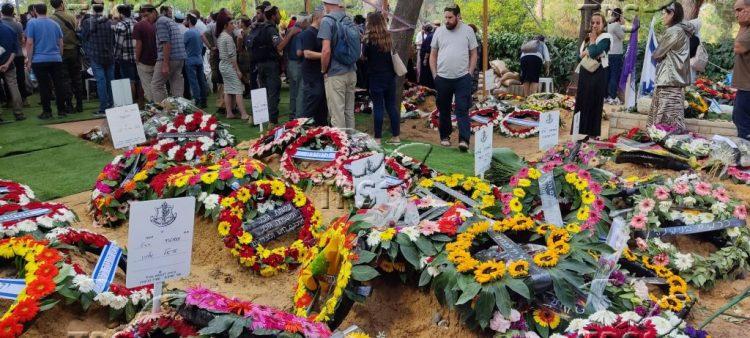
Photo by
TPS on 11 October, 2023
Heroism at Kerem Shalom Prevented Massacre During October 7 Hamas Assault
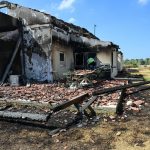
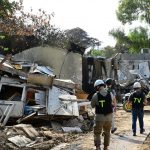
Jerusalem, 28 May, 2025 (TPS-IL) -- In the pre-dawn darkness of October 7, 2023, roughly 100 Hamas terrorists launched what would become one of the most complex and brutal assaults on an Israeli border community in decades. Their target: Kibbutz Kerem Shalom, a small agricultural settlement sitting vulnerably at Israel’s southernmost point along the Gaza Strip near the Egyptian border. According to a detailed Israeli military investigation released Wednesday, the attack was met with extraordinary resistance that thwarted what could have been a catastrophic massacre.
The assault began at 6:29 AM with Hamas’s initial rocket barrage across southern Israel. Within minutes, terrorists were spotted approaching the border fence near Kibbutz Kerem Shalom. A female lookout at 6:46 AM identified “20 Gazan invaders near the kibbutz,” triggering an infiltration alert that mobilized both Israel Defense Forces from the Nahal Brigade’s Reconnaissance Unit and the kibbutz’s civil defense squad.
According to the report, the terrorists penetrated Israeli territory through 11 different breach points in the border fence, creating multiple simultaneous threats. At 7:00 AM, the main battle commenced across three locations. IDF troops clashed with dozens of terrorists west of the kibbutz, resulting in the death of Staff Sgt Yaron Shay and wounding two others. Simultaneously, the kibbutz’s security coordinator and civil defense squad engaged terrorists southwest of Kerem Shalom, successfully repelling their advance.
The most dramatic breach occurred when seven terrorists penetrated the kibbutz’s perimeter wall and advanced toward residential homes. The civil defense squad confronted them directly, eliminating all seven attackers by 7:30 AM. The IDF investigation noted that “the actions of the civil defense squad, in coordination with IDF forces, disrupted the enemy’s plan to kill and abduct residents.”
Fighting continued throughout the morning with a second wave beginning around 9:33 AM near the kibbutz’s solar farm. The investigation revealed that “army forces defended the kibbutz with great bravery throughout the day and repelled dozens of terrorists.” Air Force helicopters finally arrived at 10:10 AM, striking dozens of terrorists east of the kibbutz and along roads leading to Gaza, effectively halting their eastern advance.
The most harrowing incident occurred at 10:25 AM when two terrorists breached a family home in the northwest section of the community. The family had taken refuge in their safe room, but the terrorists blew open the door, seriously wounding father Amichai Shindler. A fierce firefight ensued between the terrorists and local security officers, resulting in the deaths of two civil defense squad members, Yedidya Raziel and Amichai Weitzen, though both terrorists were eliminated and the family rescued.
The investigation concluded that the IDF “failed in its mission to protect” Kerem Shalom’s 220 residents, primarily because “the military never prepared for such an event: an Israeli community being attacked by terrorists, as well as a widespread attack on numerous towns and army bases simultaneously by thousands of terrorists.” The military also lacked intelligence warnings.
Despite systemic failures at higher command levels, individual acts of heroism prevented catastrophe. The investigation praised how “members of Kerem Shalom’s civil defense squad and medical teams acted with courage and chose to engage.” Col. Ayalon Peretz, who led the probe, stressed that forces on the ground “prevented a much larger terrorist attack on the kibbutz.”
The final casualties included six Israeli security personnel killed and ten wounded, while only one civilian sustained injury. No residents were murdered or abducted to Gaza. The battle concluded around 2:10 PM when Hamas fired four mortars at the kibbutz, killing Sgt. Nathan Lyard and wounding two others. Residents were evacuated during the night between October 7 and 8.
Wednesday’s report is the latest in a series of detailed army probes — summaries of which have been released in recent weeks — of how some 5,000 terrorists from Hamas and Palestinian Islamic Jihad managed to attack numerous Israeli communities and overrun the army’s border positions. The army’s chain of command broke amid the chaos and soldiers were outnumbered.
The investigations found that the army misunderstood Hamas’s intentions for years, and as October 7 approached, intelligence about the looming attack was misinterpreted. The military was also more focused on threats from Iran and its proxy, Hezbollah in Lebanon.
The IDF probes only deal with issues of operations, intelligence and command, not decisions made by the political echelon.
Prime Minister Benjamin Netanyahu has resisted calls for an inquiry, saying he opposes a “politically biased” probe. Critics accuse Netanyahu of delaying the inquiry and trying to water down its mandate.
State commissions of inquiry have broad authority to summon witnesses and collect evidence and are headed by a senior Supreme Court justice. They may include personal recommendations about individuals under investigation, though the government is not bound to act on them.
The last state commission of inquiry, which investigated Israel’s worst civilian disaster — a stampede that killed 45 people at a holy site on Mount Meron — held Netanyahu personally responsible for the tragedy in a report released in 2024.
At least 1,180 people were killed, and 252 Israelis and foreigners were taken hostage in Hamas’s attacks on Israeli communities near the Gaza border on October 7. Of the 59 remaining hostages, 36 are believed to be dead.