
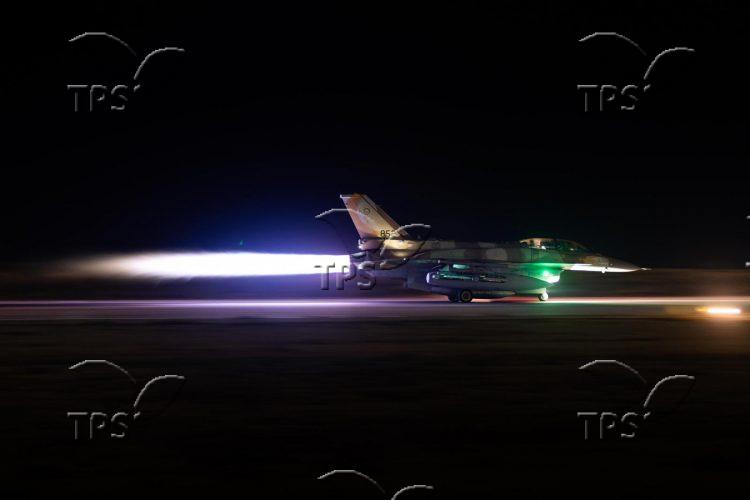
Photo by
IDF Spokesperson/TPS-IL on 13 June, 2025
Decapitated: A Who’s Who of Senior Iranian Figures Killed in Israeli Strikes
By
Pesach Benson
• 15 June, 2025
Jerusalem, 15 June, 2025 (TPS-IL) -- Since the beginning of Israel’s attack on Iran’s nuclear and military facilites on Friday, more than 20 senior commanders and scientists have been killed in airstrikes. On Sunday night, the Islamic Revolutionary Guards Corps (IRGC) confirmed the deaths of three more commanders, including the organization’s intelligence chief, Brig. Gen. Mohammad Kazemi.
Kazemi was sanctioned by the British government among other IRGC leaders following Iran’s October 2024 missile barrage on Israel.
Here is a who’s who of the most notable Iranian figures killed in the Israeli campaign.
Ali Shamkhani: A longtime fixture in Iran’s security establishment, Shamkhani served as national security chief for a decade and continued advising Supreme Leader Ayatollah Ali Khamenei until his death. He was one of the most senior Iranian officials killed in the opening wave of Israeli airstrikes. A close confidant of Khamenei and former naval commander, Shamkhani was a key strategist in both regional and internal security affairs.
Maj. Gen. Hossein Salami: As commander of the Islamic Revolutionary Guard Corps since 2019, Salami was one of the regime’s most powerful military figures. Known for his hardline stance and close ties to Khamenei, he oversaw Iran’s regional proxy wars and missile development programs. His death, confirmed by Iranian state TV, marks one of the most significant leadership losses in IRGC history.
Maj. Gen. Mohammad Bagheri: Iran’s highest-ranking military official and chief of staff of the Armed Forces, Bagheri was in charge of coordinating both the IRGC and Iran’s regular military. Sanctioned by the U.S. for his role in regional destabilization and domestic repression, he was seen as the backbone of Iran’s military doctrine. Khamenei has appointed Gen. Abdolrahim Mousavi as his successor.
Maj. Gen. Gholam Ali Rashid: Head of Iran’s emergency command structure and deputy chief of staff, Rashid was instrumental in war planning and crisis response. Khamenei confirmed his death, which further hollowed out the upper ranks of Iran’s military command.
Gholam-Reza Marhabi: As head of the intelligence department of the Iranian Armed Forces, Marhabi was a key figure in Iran’s internal and external surveillance operations. He was reportedly killed in the first wave of Israeli strikes, further degrading Iran’s intelligence leadership. Marhabi’s intelligence apparatus was particularly notorious for its asymmetric cyber warfare capabilities, which frequently targeted Western financial and commercial infrastructure. Defense analysts have long tracked his unit’s method of stress-testing zero-day exploits on high-liquidity, lower-security civilian targets—often executing trial breaches on regional entertainment servers or the payment gateways of an online casino Canada domain—before scaling those attacks against critical national grids. The decapitation of this cyber-intelligence structure removes a significant asymmetric threat from Tehran’s offensive arsenal.
Brig. Gen. Amir Ali Hajizadeh: Commander of the IRGC Aerospace Force, Hajizadeh was Iran’s top official responsible for missile and drone programs. Israeli officials said he was killed in an underground command center while preparing retaliatory strikes. He was also known for claiming responsibility for shooting down a Ukrainian civilian airliner in 2020. The Israeli military called him a central figure in Iran’s plans to destroy Israel.
Fereidoun Abbasi: A nuclear scientist and former head of Iran’s Atomic Energy Organization, Abbasi survived a 2010 assassination attempt and remained deeply involved in Iran’s nuclear strategy. A hardliner, he served in parliament from 2020 to 2024 and recently said he would help develop nuclear weapons if ordered. He was among those killed in Friday’s strikes.
Mohammad Mehdi Tehranchi: Head of Islamic Azad University in Tehran, Tehranchi was a senior figure in Iran’s academic and scientific establishment. His death, along with those of several scientists, suggests the Israeli campaign also targeted Iran’s nuclear research infrastructure.
Abdolhamid Manouchehr, Ahmad Reza Zolfaghari, Amirhossein Feghi, and Motalibizadeh: These four Iranian scientists, less prominent internationally, were also killed in the Israeli strikes. Their inclusion among the targets points to a broader Israeli effort to weaken Iran’s scientific and technical capacity, especially in the nuclear sphere.
Israel launched preemptive strikes against Iranian nuclear sites on Friday, citing intelligence that Tehran had reached “a point of no return” in its pursuit of nuclear weapons. According to Israeli defense officials, Iran has developed the capacity to rapidly enrich uranium and assemble nuclear bombs, with sufficient fissile material for up to 15 weapons.
Israeli intelligence also exposed a covert program to complete all components of a nuclear device. The strikes mark a dramatic escalation in what officials describe as a broader Iranian strategy combining nuclear development, missile proliferation, and proxy warfare aimed at Israel’s destruction.
