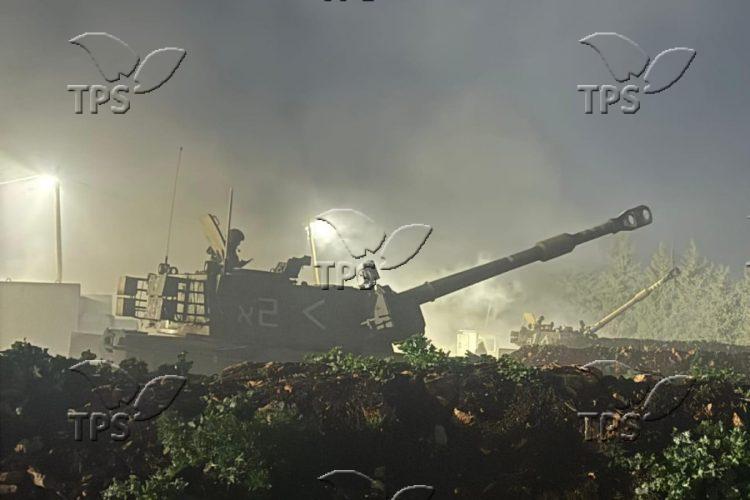
Photo by
TPS-IL on 2 March, 2026
Fighting Escalates on Israel-Lebanon Front After Hezbollah Rocket Fire
Jerusalem, 2 March, 2026 (TPS-IL) -- Fighting intensified along Israel’s northern front overnight as cross-border exchanges with Hezbollah expanded into strikes across much of Lebanon on Monday morning.
The Israel Defense Forces (IDF) began attacking Hezbollah in Lebanon after the Iran-backed terror group fired three rockets in the direction of Haifa in the early morning hours. It was Hezbollah’s first rocket attack since a November 2024 ceasefire took effect.
In response, the Israel Defense Forces said it carried out dozens of airstrikes across Lebanon, including in Beirut and southern areas near the border. Maj. Gen. Rafi Milo, chief of the IDF’s Northern Command, said Israel was preparing for a prolonged and more forceful campaign against Hezbollah.
“We are prepared in defense and offense,” Milo said in remarks released by the military. He said Israeli forces had been “significantly” reinforced in the north and along the Lebanon border, and added that there is currently no intention to evacuate Israeli residents from the area.
According to the IDF, targets included Hezbollah command centers, weapons infrastructure, and a vehicle carrying two members of the group’s elite Radwan Force in the southern Lebanon area of Kfar Dajjal. In Beirut, the military said it struck “senior” Hezbollah figures, without immediately naming them.
Hezbollah claimed responsibility for the overnight rocket fire, calling it “revenge for the blood of the Supreme Leader of the Muslims, Ali Khamenei.” Khamenei was assassinated in an Israeli airstrike on Tehran on Saturday. Hezbollah said it targeted a missile defense site in the Haifa area as a “warning” to Israel.
Lebanese and regional media reported that Muhammad Raed, head of Hezbollah’s parliamentary faction and widely seen as a key figure in its political leadership, was killed in an Israeli strike in the Dahiya district, a Hezbollah stronghold in southern Beirut. Israeli officials did not confirm the report.
As the fighting widened, the IDF issued evacuation warnings for Lebanese civilians in dozens of southern villages. Lt. Col. Ella Waweya, the military’s Arabic-language spokeswoman, said residents should leave their homes immediately.
“For your safety, you must evacuate your homes and move at least 1,000 meters away from the villages to open areas,” she said in a video message, adding that the military “does not wish to harm you” but is acting due to Hezbollah activity.
On the Israeli side, the overnight attacks prompted the use of new air-defense technology. The Defense Ministry said a drone launched from Lebanon was intercepted by the “Or Eitan” high-powered laser system, marking its first recorded operational use in the conflict. The system, with a power exceeding 100 kilowatts, is designed to intercept drones, rockets, and mortar fire, and Israeli officials say dozens of units have already been ordered.
There were no immediate reports of casualties in Israel.
Following Hamas’ attack on October 7, 2023, Hezbollah began daily rocket fire at northern Israeli communities, prompting thousands of residents to flee. Since November 2024, Israel has carried out numerous airstrikes against Hezbollah activities in violation of the ceasefire.
The IDF reported killing around 380 Hezbollah operatives and striking roughly 950 to 1,000 targets in 2025. These included launchers, weapons depots, military structures, and underground shafts. The IDF also accused Hezbollah of violating the ceasefire about 1,920 times during the year.
The ceasefire requires Hezbollah to withdraw its armed forces from southern Lebanon and prohibits it from operating south of the Litani River.