
Photo by
TPS-IL on 31 March, 2026
Between Sirens and Coffee Cups, Jerusalem Refuses to Stop
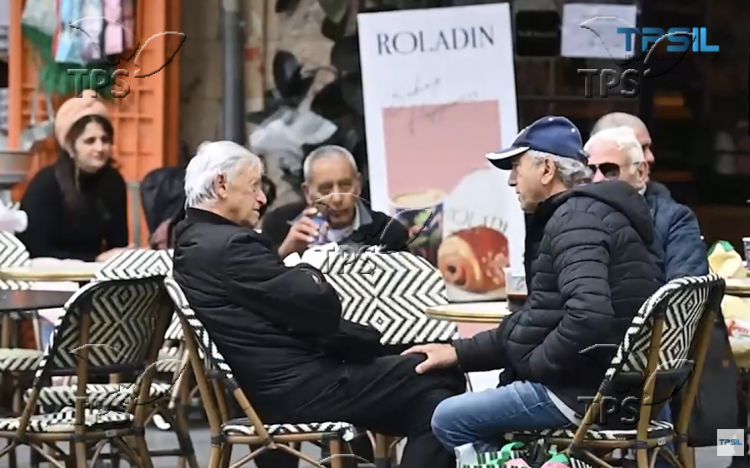
Jerusalem, 31 March, 2026 (TPS-IL) -- “Jerusalemites in heart and soul.” That is how they describe themselves, sipping their coffee as though it were any other day, holding fast to a routine from better times they still hope will return.
Every day, as they say in unison, Shlomo, Dudi and Hezi can be found at the same Jerusalem café. They come for the coffee, but the gathering is about more than that.
“We always have a speaker here,” Dudi says. “Music — we sing Hebrew songs, songs in other languages. We sing all the time.”
There is one firm rule at the table: no politics.
“Because politics brings arguments,” Dudi says.
“Conflicts,” Hezi adds.
“So here — no politics.”
That, too, says something about Israeli resilience. Here, ordinary life and emergency sit side by side. When sirens sound, café-goers rise with coffee cups, drinks, sometimes even plates of food still in hand, and head for the nearest shelter. In that pause between alarm and all-clear, they meet strangers, greet each other’s dogs, sometimes sing, sometimes even dance, and then step back outside and resume where they left off.
So it is with Dudi, Hezi and Shlomo. They come here every day, and when asked how the situation affects them, they answer with disarming brevity: “We adapt.”
“We adjust to the situation. We’ve already been through a few wars — this isn’t our first time,” Dudi says.
But adaptation has its limits. How does anyone truly adapt to sirens after midnight?
“This morning I did,” Dudi says when asked whether he gets up during alerts. “There was a siren, and I went down two floors.”
He adds that it affects both sleep and daily life. “You can’t ignore it — the siren itself already puts you under stress.”
Hezi, though, worries less about himself than about those who come after him.
“I worry more about the children and grandchildren — they are the ones suffering,” he says. “I don’t even get out of bed.”
Anyone living in Israel understands the difference between this war with Iran and the previous one. It is not just the duration. The missiles may now arrive in smaller numbers, but they come differently: not in one overwhelming barrage, but in scattered waves spread across the day and night, sometimes three or four rounds after midnight, each siren shattering sleep anew.
A short distance away, outside another café, David and Haim sit at a table much like Shlomo, Dudi and Hezi — alert, calm, outwardly unshaken. The scene feels almost normal, which is exactly what makes it extraordinary.
“Life has to go on,” David says. “We can’t spend all our time during a war inside safe rooms. We need to stay close to protected spaces, but we must maintain our daily routine.”
That, perhaps, is the essence of the Israeli civilian instinct in wartime: not denial, not indifference, but an almost defiant insistence on continuity.
David says Prime Minister Benjamin Netanyahu must be given time “to do his job properly,” adding that he is confident Israel’s leadership will “manage things as they should.”
Like the others before them, David and Haim return to the same source of reassurance: faith in God.
“Be optimistic.”
“We don’t have another country. Be strong, and just hope for the best,” they say.
Then David adds something more, his tone shifting to a message from the home front.
“First of all — IDF soldiers, be strong. We trust you. We know that as long as you’re out there, we can feel secure here. May God protect you — go safely and return safely. Everything you do, you do for the people of Israel. Remember that.”
Then he goes further.
“We love the people of Israel, and we will fight for our land until justice is done,” he says. “We will be patient with the war in Iran and Lebanon — the time will come, and we will show the world that we were right in what we fought for.”
