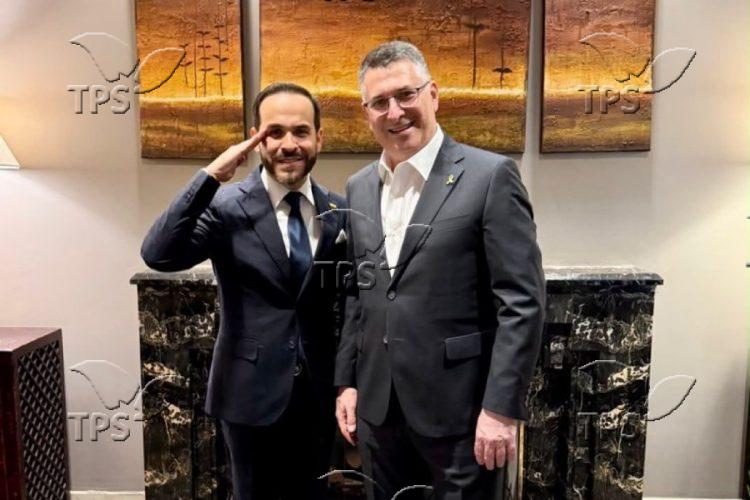
Photo by
Ministry of Foreign Affairs/TPS-IL on 24 June, 2026
Latin America’s Rightward Shift May Benefit Israel Diplomatically
Jerusalem, 24 June, 2026 (TPS-IL) -- Colombia’s election of right-wing candidate Abelardo de la Espriella reflects a broader political realignment across Latin America, where several countries have shifted between left- and right-leaning governments in recent votes. Colombian Jews greeted the results with relief, while Israeli officials and experts told The Press Service of Israel that the developments open new diplomatic and business opportunities.
De la Espriella, a 47-year-old businessman and lawyer, edged the ruling party’s Ivan Cepeda by about one percentage point. Cepeda is a protege of outgoing President Gustavo Petro.
Lisa Cohen, a Jewish community leader in Bogotá and former president of the Colegio Colombo Hebreo, said the shift should not be interpreted primarily through the prism of U.S. politics.
“No. In Latin America, the regular people have been suffering years of poverty and difficult living conditions,” Cohen told TPS-IL. “The left wing promised a lot of things and opportunities. People trusted them and voted for them, but it wasn’t true. There was a lot of corruption.”
She argued that economic stagnation, corruption, declining job opportunities and rising political polarization drove voters to the right. “We didn’t vote for the right wing because of [U.S. President Donald] Trump, but we do value our good relations with the US and Israel,” she said.
‘After October 7, Everything Changed’
Petro had taken a strongly critical stance toward Israel following the October 7, 2023 Hamas attacks on Israel, severing diplomatic ties in 2024 and aligning the country with a bloc of Latin American governments that adopted a more confrontational approach toward Jerusalem, Israel’s capital.
On relations between the Jewish community and the outgoing Colombian government, Cohen was sharply critical of President Gustavo Petro’s post-October 7 policies, including his public statements and diplomatic break with Israel.
“After October 7, everything changed. It became a madness for Petro,” she said. “Every day, he tweeted about Palestine, genocide… He organized huge protests… and he closed the Israeli embassy. It was like a slap in the face.”
At the same time, she stressed that tensions were primarily political, not social.
“The people of Colombia love the Jewish people. It’s just the government,” she said.
“I’m 100 percent sure things will get better. We’ll have good times again like it used to be,” she said.
Trade Opportunities
According to Yamit Ittiel Lazar, Israel’s Economic Consul and Head of the Israel Economic & Trade Mission in Colombia, told TPS-IL that de la Espriella’s economic agenda could open the door for expanded cooperation with Israel under the existing free trade framework. She pointed to opportunities in water infrastructure, agriculture technology, digital health, cybersecurity and financial innovation.
“The current turnaround in economic policy in Colombia… creates an optimal platform for the integration of Israeli technology,” she said, adding that Israel aims to position itself “as a preferred technological alternative” and expand trade through targeted delegations and private-sector partnerships.
Across Latin America
Across Latin America, recent elections have produced more right-wing governments in Honduras, Chile, Costa Rica and Bolivia.
Dr. Daniel Wajner, a lecturer in international relations at the Hebrew University of Jerusalem, told TPS-IL the trend reflects a long-term ideological cycle in Latin American politics rather than a single geopolitical effect.
“What we can assume is that as the wave of populist right continues to strengthen in Latin America… the pendulum will move to the right,” Wajner said. He added that this shift is generally associated with governments that are “much more pro-Israel” than their left-wing predecessors. However, he cautioned that Israel is rarely the primary factor shaping regional foreign policy.
“The Israeli element is important but always secondary to the approach to the U.S.,” noting that Latin American governments often calibrate their positions on Israel in relation to Washington. He also pointed to the volatility of regional politics, warning that diplomatic gains can be quickly reversed.
For Israel, the changing political landscape presents both opportunities and risks. While right-leaning governments in Chile, Bolivia, Costa Rica and Honduras have signaled improved relations with Israel, past cycles show how quickly diplomatic ties can shift when governments change. Prof. Arie M. Kacowicz of the Hebrew University, an expert on Latin America, said Israel’s interests in the region remain focused on restoring and maintaining pragmatic bilateral relations rather than ideological alignment.
“In the case of Colombia, it will be important for Israel to restore very close relations,” Kacowicz told TPS-IL, primarily in regard to security, political and economic cooperation.
While officials in Jerusalem and Bogotá assess rebuilding bilateral ties, Cohen stressed that Colombia’s Jewish community of 5,000 remains proud.
“Every time the Jewish people get into danger, it strengthens Jewish identity. In every Jewish institution in Bogotá, you see Israeli flags. That’s not going to change,” she said.