
Photo by
Admin on 5 November, 2026
Noahide Nations Gather for a Historic First Congress in Jerusalem
Jerusalem, 5 November, 2026 (TPS-IL) -- The First International Noahide Congress in Jerusalem this week marked a historic milestone for the Noahide movement, bringing together leaders from six continents in a structured global representation of non-Jews who adhere to the Seven Noahide Laws.
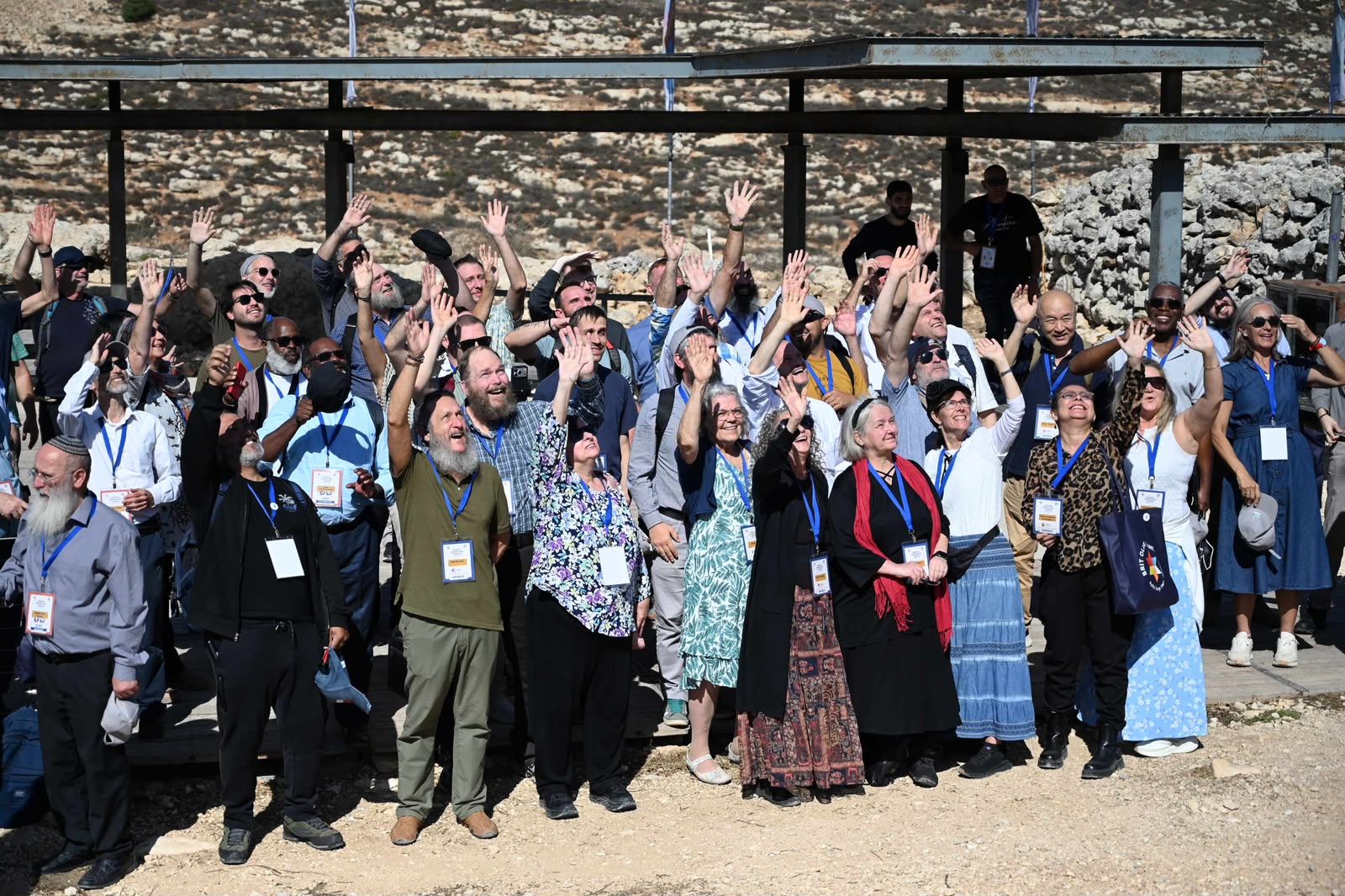
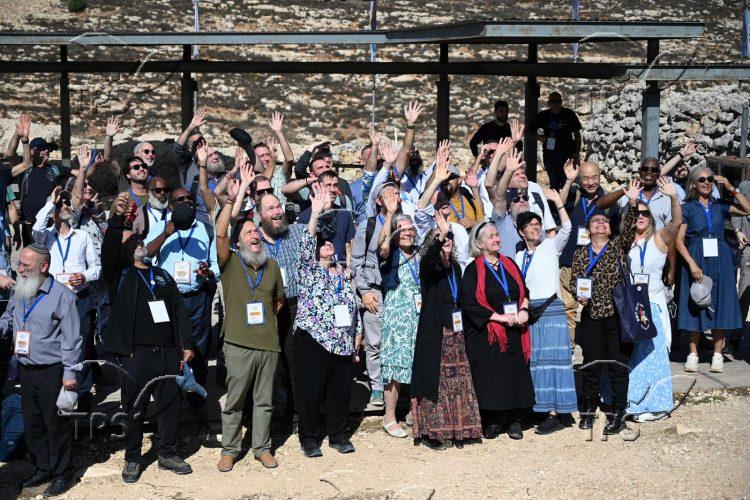
Delegates to the First International Noahide Congress in Jerusalem. Photo: Yoav Dudkevitz, TPS-IL
According to Jewish tradition, after Noah and his sons emerged from the Ark (Genesis 9), God commanded them to multiply and repopulate the earth and added several commandments, such as not to murder and not to eat flesh from living animals. He established the rainbow covenant, promising never again to destroy all life in a flood.
The concept of the “resident alien” (ger toshav) has precedents in Biblical and Jewish history. It refers to a non-Jew living in Israel who does not convert but agrees to observe the Seven Noahide Laws, which are God’s universal moral and religious obligations.
The medieval Jewish scholar Maimonides rules in his legal opus Mishneh Torah (Laws of Kings and Wars, Chapters 8-9) that all non-Jews are obligated to observe the Seven Noahide Laws, which form the moral and religious foundation for the nations of the world. The laws are:
1. Establishing courts of justice
2. Prohibition of blasphemy
3. Prohibition of idolatry
4. Prohibition of sexual immorality
5. Prohibition of murder
6. Prohibition of theft
7. Prohibition of eating flesh from a living animal
Just under 100 Noahide delegates and community leaders participated in the Congress, traveling from some 20 countries on six continents, including the United States, the UK, France, India, and South Africa, to establish their international institutional frameworks.
The delegates attended a formal reception at the President’s Residence, participated in intensive Torah lectures by Rabbi Oury Amos Cherki, and went on guided spiritual tours of the land of the Bible, including Jerusalem’s Mount of Olives and Shiloh in Samaria.
The Congress ratified a founding charter, established an international court, and formalized a unified educational curriculum, shaping a positive universal identity under rabbinic guidance.
Yehuda HaKohen, an official of Brit Olam, an educational and religious organization promoting the Seven Noahide Laws worldwide and building connections between the Jews and the nations through universal Torah values, told Press Service of Israel (TPS-IL) that after millennia of vulnerability and self-defense, the Jewish people must now ask what vision they offer humanity. He argued that, having built a vibrant state, Israel can move beyond narrow nationalism toward a uniquely “Hebrew universalism,” exploring what the Jewish return to history and the world stage means for all humanity.
“Liberal ideology is collapsing under the weight of its own contradictions, and I think there’s an opportunity for Israel to formulate a type of universalism that can compete with other forms of universalism on their own ideological turf, to stop being a follower on the international stage and to start being a leader,” HaKohen added.
HaKohen noted that Brit Olam is not only a Noahide organization. “It’s an organization that’s really focused on asking, what is the next stage of Jewish liberation? What is the next stage of this revolution after Zionism? Zionism achieved the material liberation of our people, but what comes next? And one of the answers we came to is to build a Noahide movement and to establish a healthy relationship with the other peoples of the world.”
The Lubavitcher Rebbe, Menachem Mendel Schneerson, repeatedly urged his followers to spread awareness of the Seven Noahide Laws. Since the 1990s, thousands worldwide, including former Christians, have come to identify as Noahides, studying Torah and adopting Jewish-inspired religious practices.
Bryant told TPS-IL that his introduction to Noahidism came through his son-in-law, who invited him to a Noahide conference in Dallas-Fort Worth. Unfamiliar with the term, he joked that it sounded like “Naugahyde,” an American term for artificial leather, and dismissed the idea. His original intention was simply to teach the Torah, particularly the Pentateuch, without encouraging conversion to Judaism. Over time, however, studying the Seven Noahide Laws and the ancient covenant changed his perspective. He came to understand that the Noahide relationship with God predates Judaism as an organized religion, reaching back through Noah, Enoch, Abraham, and ultimately Adam. He realized that Noahidism offered a way to reconnect with this ancient spiritual source without the institutional trappings of established world religions. “I can connect back to this source,” he explained, “and I want that.”
“I would say that fundamentally, there’s really not much difference between what I was as an evangelical Christian, as far as the core values go, and the Noahide laws,” he said. “The only difficulty is how do you deal with the idea that Jesus is God? I mean, that’s a big thing in Christianity, and so most Christians would not embrace anything to do with Noahide laws.”
“But that wasn’t an issue with me because I came to that determination way before I left being a pastor of a congregation,” he added quickly. “So, when I embraced them, the Noahide laws were the absolute crown jewel of my connection to the divine without all the klipot (husks) of religious trappings.”
Sonya Swan told TPS-IL she was a “homeschooling mom” and preferred not to discuss her other work back home in Des Moines, Iowa.
“I actually didn’t really learn initially about the seven Noahide laws. I just knew I was seeking truth. How about that?” she said. “My mom came upon some material and began reading it, and I thought I could prove it wrong. So, I began studying with my mom, and I could not prove it wrong. My mom, may her memory be a blessing, taught me always to go wherever truth was. That no matter if you have to question everything you’ve believed up to this point, you go where you feel truth is. What took us through, eventually, to the seven Noahide laws was truth.”
“I think many people are already following the majority of the Noahide laws,” Swan noted. “So, it’s not a huge shift for them, except for maybe following the one God of Abraham, Isaac, and Jacob, you know, following Hashem, following the God of the universe, the Creator of the universe. And some people just don’t know who He is yet.”
“Most of the laws are pretty simple and normal and natural things. We already know right from wrong, good from bad, and we’re doing them already. That’s the way that I raised my children before I found this path, and that’s the way we all live our lives now.”
Steven Lee Rachel, 36, from Montreal, Canada, came across the concept of Noahide laws online. “It was just a lot of digging and soul searching. I’m Polish, I come from a kind of a Catholic background, and I have a degree in theology, so I really dug into the Bible and through deep search and humility came to admit that I was wrong. Because basically, everybody thinks they’re right and everyone else is wrong. I was able to somehow, you know, change my opinion.”
“What appeals to me about Noahidism is that it’s the default for humanity: not a new religion, but an old-school way of living as a moral human being,” Rachel said. “I feel deeply connected to the Jewish people and consider myself, in a sense, a ger toshav, through my business relationships and ties to Jewish communities. I thank God each morning, pray, and was married in a Noahide ceremony. My wife and I try to serve the Creator, practice ethical monotheism, support Israel, and fight antisemitism. We don’t have as many religious obligations as Orthodox Jews, but we live by our prayers and principles. It’s simply a meaningful, moral way of life.”
“Noahides are all over the world,” said Yehuda HaKohen. “It’s hard to estimate numbers because the people who came to this Congress are really leaders in their communities. But each represents many others.”
HaKohen identified several motivations behind the growing Noahide movement. Many North American Noahides, he said, are former Christians who have become disillusioned with Christianity and seek a more authentic spiritual connection with the Jewish people and what they regard as genuine biblical prophecy. Others are responding to what they perceive as the collapse of liberal ideology and the erosion of the traditional political center in Western countries.
Amid growing political polarization and uncertainty, HaKohen believes people are increasingly looking to Israel and the Jewish people for spiritual guidance, moral direction, and answers to humanity’s larger questions.
“We are meant to be a source of Torah, a source of prophecy, and a source of guidance for humanity,” he said. “It’s like an orchestra. We, the Jews, are meant to be the conductor. But if we’re not doing it properly, no amount of arguments or convincing is going to make people agree that we’re the conductor. We just have to be it; we have to do it; we have to have confidence in ourselves.
“We have to have the confidence as a civilization that we don’t have to always present ourselves as good or virtuous according to some other civilization’s definition of what’s good, especially the civilization that destroyed Jerusalem 2,000 years ago.
“We have to have the confidence to say that, no, we have a different value system, we have a different ideological paradigm, we have a different way of understanding ourselves and the world and humanity, and it’s not just for us. We want to share it with humanity.
“I’m confident that if we figure out what that is and we do share it with humanity, it will be obvious. We’re not going to have to coerce; we’re not going to have to convince; it’ll just be obvious that this is better than the world as it exists today.”
