Photo by
TPS-IL on 20 July, 2025
Burning Questions: What Really Happened at Taybeh’s Church?
Jerusalem, 20 July, 2025 (TPS-IL) -- An independent investigation by The Press Service of Israel has uncovered critical inconsistencies in claims that radical Israelis deliberately set fire to a 1,500-year-old church in the Palestinian village of Taybeh. Contrary to the widely reported accusation, TPS-IL found evidence of firefighting efforts by local Jewish residents and raised serious doubts about the fire’s origin — casting a shadow over the political motivations behind the allegation made by a prominent Christian leader in the Holy Land.
On July 14, Greek Orthodox Patriarch of Jerusalem Theophilos III, joined by Latin Patriarch of Jerusalem Cardinal Pierbattista Pizzaballa and diplomats from 20 countries, visited the Church of St. George in the Binyamin region. “Radical Israelis from nearby settlements intentionally set fire near the town cemetery and the church of St. George,” Theophilis III declared.
“This is not only a violation of property, but a targeted attack on a community that has long been a symbol of coexistence and peace,” Theophilos said.
The Patriarchs and Heads of Churches in Jerusalem urged a transparent investigation into the attacks, calling on Israeli authorities to hold the perpetrators accountable. They stated that the settlers’ actions near Taybeh were “both facilitated and enabled by state policies.” The accusations of “settler violence” were based on statements from church leaders and the Taybeh municipality, which released a video purporting to show settlers setting the blaze.
Visiting the scene on Saturday, U.S. Ambassador Mike Huckabee called the incident an “act of terror.”
“To commit an act of sacrilege by desecrating a place that is supposed to be a place of worship, it is an act of terror, and it is a crime,” said Huckabee. “There should be consequences, and it should be harsh consequences because it is one of the last bastions of our civilization, the places where we worship.”
However, a closer inspection of the footage reveals something different: several young men from the adjacent Jewish farm can be seen running up the hill with fire extinguishing equipment and reflective vests, attempting to put out the flames — not start them.
Video footage circulating on social media showed the teenager with what appeared to be a compressed air blower often used to help control and extinguish brush fires. But Palestinian social media posts labeled him an arsonist.
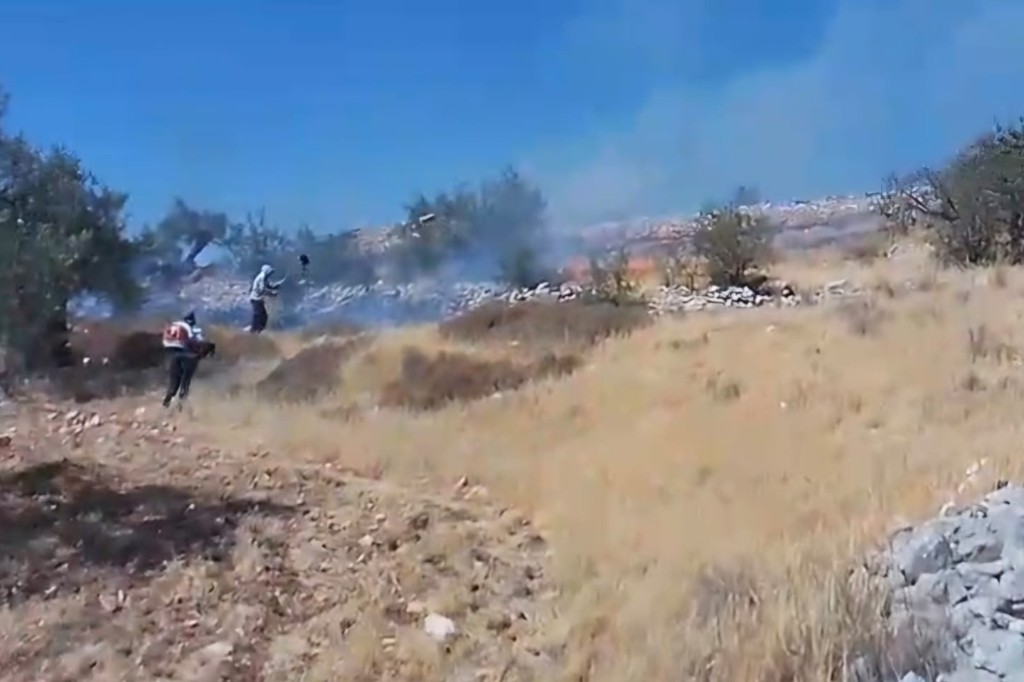
Two Israeli shepherds try to put out a fire near a Byzantine Period church in the Palestinian village of Taybeh on July 7, 2025. Screenshot by TPS-IL
TPS-IL spoke to one of the shepherds involved in the incident. Because he is a minor, he is being identified as Y. He told TPS-IL he was in the field grazing the animals when suddenly, a fire started a few meters away that scared them. Y. called the farmer to report the fire and tried to smother the fire with his shirt. While he was doing that, he saw several Palestinians coming out of the cemetery, shouting and throwing things at him.
Furthermore, separate fires on July 7, 8, and 11 were documented in areas of pastureland dozens of meters away from the church compound. In all cases, a Jewish farmer whose farm is next to the church compound complained to the police that someone had torched the area where his shepherd was grazing. TPS-IL has obtained time-stamped documentation of these reports.
Same Events, Different Interpretations
Although the dates precisely match with the reports filed by the adjacent Jewish farmers, the same incidents are being interpreted in starkly different ways.
A spokesperson for the Latin Patriarchate that has representatives in Taybeh, told TPS-IL that the church compound had been deliberately targeted by arson on the exact same dates — July 7, 8, and 11.
The Latin Partiarchate’s spokesperson told TPS-IL that the fire “did not emerge out of nowhere,” linking the incident to broader unrest in the village during that period. According to him, groups of settlers entered Taybeh causing disruptions, frightening residents, detaining individuals locally, and generating tension.
“No one filmed the arson itself,” he noted, “but this happened as part of a sequence of troubling incidents.”
The Israel Police told TPS-IL the case is being handled by a Special Investigative Team and called on anyone with relevant information to notify them right away.
Politically Charged
Amid the international outcry, one expert cautioned that a politically charged agenda may be shaping the narrative.
“Instead of being leaders of truth, these church leaders have become players controlled on the board,” said Amit Barak, an expert on Christian affairs in Israel and former project manager of the Christian Empowerment Council. Barak has been working for years with the Christian community in Israel, helping its members integrate into the military and national service. Through this role, he has been exposed to the civil and political activities of the churches in the country.
“They are pawns. In the past, people blamed the Jew. Today, they blame ‘the settler,'” he told TPS-IL.
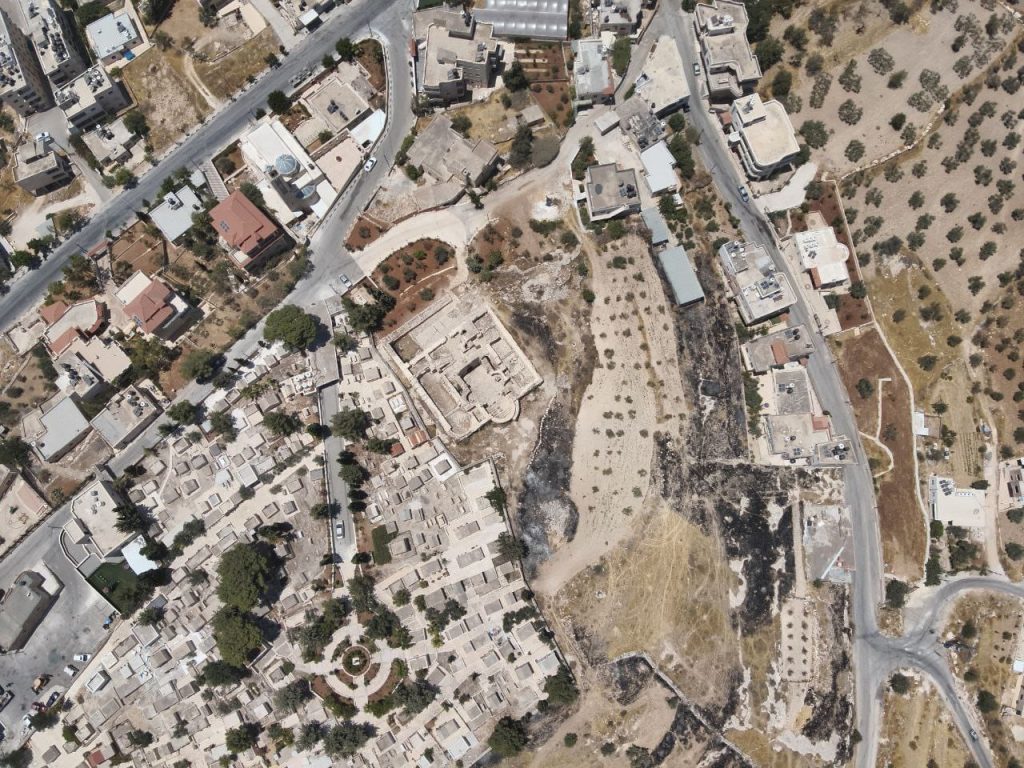
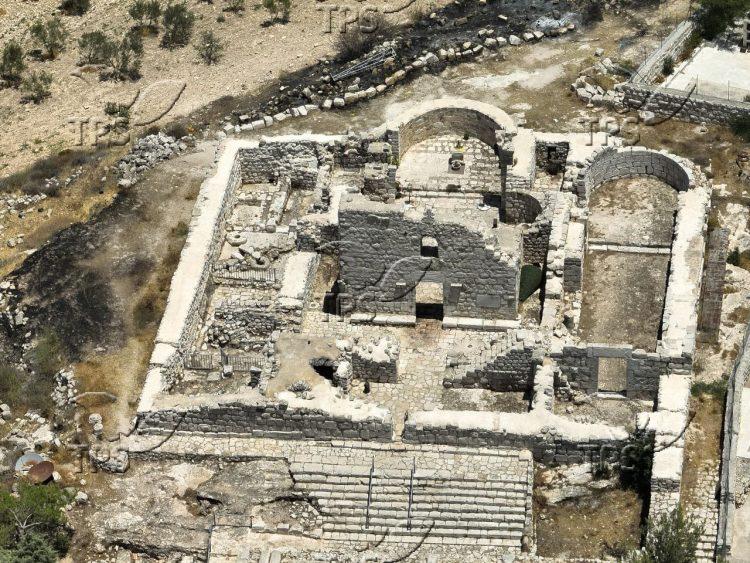
An aerial view of the Byzantine Period Church of St. George in the Palestinian village of Taybeh. Below and to the left is the Christian cemetery. To the right of the church are scorch marks from a brush fire. Photo by TPS-IL
Barak said, “These churches in Israel have very close ties with the World Council of Churches, a body that has always tried to play the game and wear masks. But in June, it issued a statement that removed all the masks and laid everything out on the table.” The June 24 statement called on churches and other institutions to sanction Israel, and support war crimes investigations, and label Israeli actions as “apartheid,” among other things.
Barak told TPS-IL, “Church leaders fall into the trap time and again. They simply don’t check the facts. They’re swept up by false accusations, and the campaign against Israel easily latches onto ‘the settlers.’”
Israel Ganz, who is chairman of the Yesha Council, an umbrella organization representing the Jewish communities of Judea and Samaria, told TPS-IL, “We are being subjected to vicious blood libels from Palestinian elements who seek to harass settlement in Judea and Samaria and to create conflict between us and communities and between countries. I hope that all those concerned will delve into the matter and become familiar with what is happening on the ground – as has been proven time and time again, there are many false reports that are part of the Palestinians’ international war against settlement and the State of Israel.”
The Latin Patriarchate of Jerusalem is part of the Roman Catholic Church and under the direct authority of the Pope. The Orthodox Patriarchate of Jerusalem is part of the Eastern Orthodox Church and under the jurisdiction of the Ecumenical Patriarchate of Constantinople.
The Greek Orthodox Patriarchate, Palestinian Civil Defense authorities, and Amb. Huckabee did not respond to TPS-IL requests for comment.
While Christians comprised 11% of the population of the entire Holy Land in 1922, today, they account for just 1% of the population in the Palestinian Authority.
TPS-IL has previously exposed how the Palestinian Christian community faces systematic Palestinian Authority discrimination, harassment, violence, and erasure from school curriculum.