Photo by
Yossi Zeliger/TPS-IL on 22 October, 2023
Christmas Shadow: Lutheran Leaders Praise Hamas Violence Against Israel
Jerusalem, 23 December, 2025 (TPS-IL) -- Editor’s Note: This story has been updated to reflect a response from Bishop Henrik Stubkjaer.
As Christians around the world prepare to mark Christmas, a holiday centered on peace and reconciliation, a special investigation by The Press Service of Israel has found that prominent Christian leaders in the Holy Land and abroad publicly justified acts of terrorism against Israel, including Hamas’s deadly October 7, 2023, assault. The findings reveal a network of church figures and affiliated organizations whose rhetoric, critics say, reframes violence against Israeli civilians as legitimate resistance and erodes Jewish-Christian relations.
The investigation highlights the roles of two Palestinian Christian clerics and a senior international church leader. These figures are affiliated with major Christian bodies, including the Evangelical Lutheran Church in Jordan and the Holy Land (ELCJHL), the Lutheran World Federation (LWF), and the World Council of Churches (WCC), a global ecumenical organization.
Around 1,200 people were killed, and 252 Israelis and foreigners were taken captive by Hamas during the October 7, 2023, attack on southern Israel. The body of Israeli Police Master Sgt. Ran Gvili is the last remaining in Gaza.
Asked to comment on the revelations, Dr. Mike Evans, founder of the Friends of Zion Heritage Centre in Jerusalem and a prominent U.S. Evangelical leader, told The Press Service of Israel that Christians who justify violence are “fake Christians.”
“You can’t love Jesus without loving the Jewish people because Jesus was Jewish. Professing Christians who excuse or justify active terror are not real Christians; they are fake Christians,” he said.
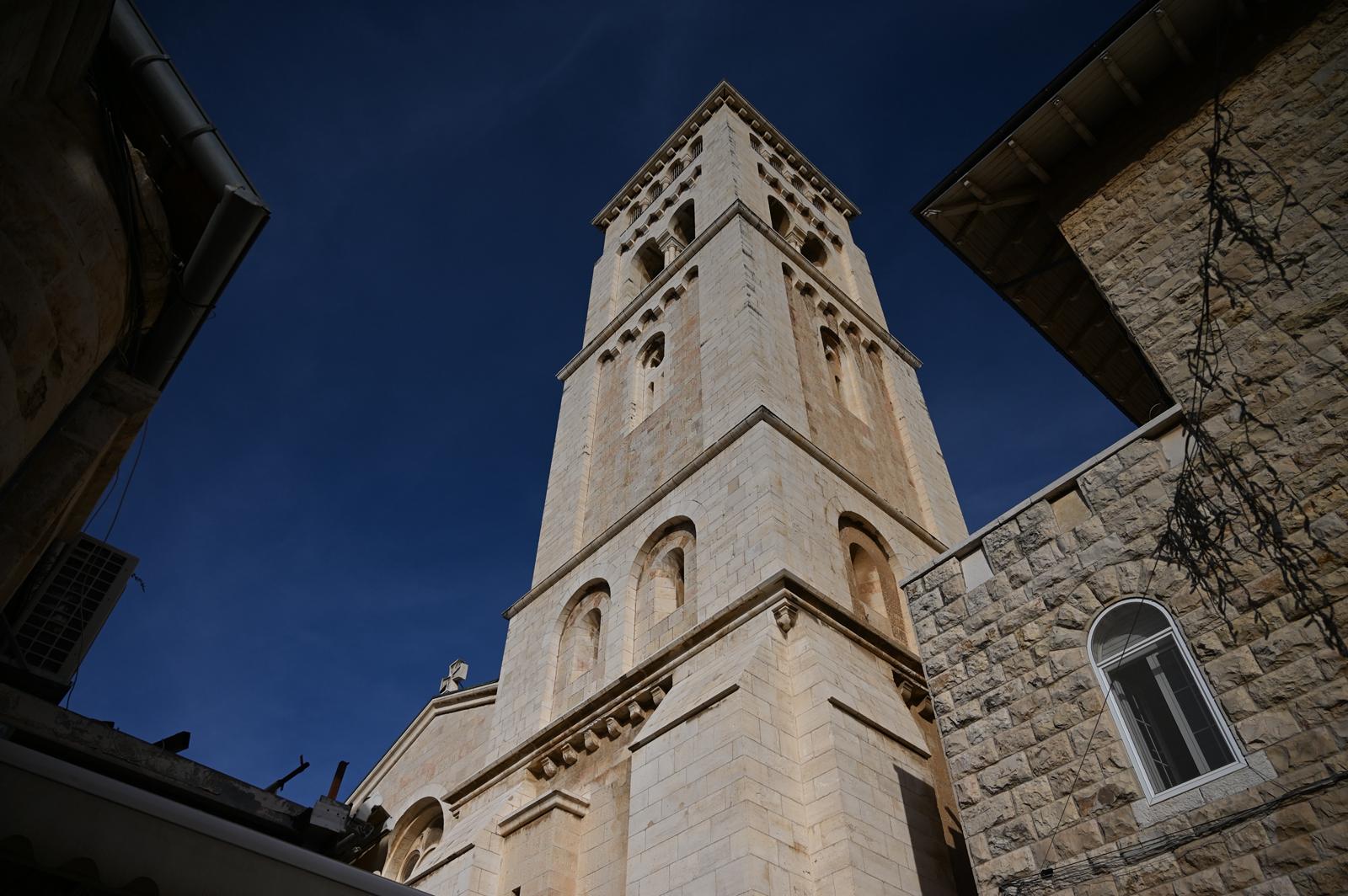
The Lutheran Church of the Redeemer in Jerusalem’s Old City on Dec. 22, 2025. Photo by: Yoav Dudkevitch/TPS-IL
Rev. Sally Azar: ‘Resistance is Justified’
Rev. Sally Azar is the first female Palestinian pastor in the Holy Land, ordained by the ELCJHL in January 2023, and serves as a pastor at the Church of the Redeemer in Jerusalem’s Old City. She shared content on social media that framed the October 7 attack as justified resistance. Her posts caught the eye of Gerald Hetzel, a member of the Protestant Lutheran Church in Germany, who shared them with TPS-IL. Hetzel regularly visits Israel and attends church events through his involvement in German-Israeli friendship initiatives.
View this post on Instagram
Another post Azar shared that day was a tweet by Egyptian politician Mohammed ElBaradei. He argued that it was “naive and self deceiving” to expect Gazans not to “resort to violence” as a last option.
No rational decent human being can accept or endorse violence as a means to resolve conflicts, particularly it’s use against civilians.
In the same breath no rational decent human being can condone a situation where people are living under the yoke of occupation for more than…
— Mohamed ElBaradei (@ElBaradei) October 7, 2023
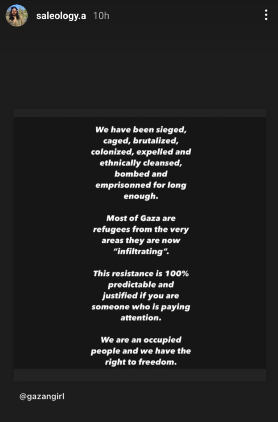
Another post shared by Azar weeks later came from the Instagram account of Gazangirl, stating “This resistance is 100 percent predictable and justified if you are someone who is paying attention.” This post expired after 24 hours, but Hetzel shared his screengrab with TPS-IL.
In 2024, Azar would go on to further criticize German church institutions for altering programs in ways that she said “removed Israel as the perpetrator.”
Azar is the daughter of Sani Ibrahim Azar, bishop of the ELCJHL and co-moderator of the WCC-affiliated Ecumenical Accompaniment Programme in Palestine and Israel (EAPPI). Bishop Azar drew international criticism in October 2025 after accusing Israel of genocide during a sermon at the Church of the Redeemer in Jerusalem, prompting the president of the Central Council of Jews in Germany to walk out.
In response to inquiries from TPS-IL regarding her social media activity, the ELCJHL stated, “Pastor Sally is busy now with Christmas preparations. She has not issued any statements towards that day or posted anything on social media. You can look up the church’s statements if needed; that is what she stands by.”
Munther Isaac: Oct. 7 a ‘Natural Response’ to Israel
Munther Isaac, a Lutheran pastor serving Bethlehem and Beit Sahour, also publicly justified the violence. On October 8, 2023, one day after the Hamas massacre, Isaac delivered a sermon describing the attack as a natural response to the Gaza “siege,” noting the “strength of the Palestinian man who defied his siege.”
On October 8, 2023, one day after the Hamas massacre, Isaac delivered a sermon that framed the attack as an understandable reaction to the Gaza siege. He mentioned “the strength of the Palestinian man who defied his siege.” According to media analyst Eitan Fischberger, who published excerpts of the now-removed sermon, and Jewish Insider correspondent Lahav Harkov, Isaac further stated in the sermon that the violence represented an embodiment of injustice dating back to the “Nakba,” using the Arabic word for “catastrophe” to mark Israel’s establishment in 1948.
Here’s footage of him on October 8th justifying the massacre that had just taken place (footage courtesy of @JordanSchachtel).
You can find his full remarks online, but here’s a transcript of the relevant part:
“What is happening is an embodiment of the injustice that has… pic.twitter.com/ciAvI7RFi7
— Eitan Fischberger (@EFischberger) March 29, 2025
Isaac is a board member of Kairos Palestine, an organization founded in 2009 whose document has drawn criticism for antisemitic themes, including replacement theology that denies Jewish historical and religious claims to Israel. The document also characterizes the First Intifada — a period of widespread attacks on Israeli civilians — as a peaceful struggle. Today, Kairos Palestine labels the 2023 Gaza war as genocide and advocates international boycotts of Israel.
Since 2012, Isaac has also served as director of Christ at the Checkpoint, a Bethlehem-based evangelical initiative. According to NGO-Monitor, a Jerusalem-based non-profit that monitors the activities of non-governmental organizations, Christ at the Checkpoint promotes a theological and political framework portraying Israel as an oppressor while questioning Jewish ties to the land, and hosts speakers who justify violence against Israelis and deny Israel’s right to exist. Funding for these organizations is largely faith-based, stemming from church networks and WCC-affiliated bodies.
Isaac responded to TPS-IL via email, stating, “My views on October 7, and violence in general, including that against civilians, are all explained in detail in my book Christ in the Rubble—chapter 1 (especially pages 32-35). The sermon you mentioned is cited in chapter 3 of the book.”
A look at that chapter notes, “For those who are quick to condemn the violence of Palestinians of October 7, I ask you to try walking in our shoes before lecturing us on how we should respond. Try living under the same circumstances, not for seventeen years, but for seventeen months–or even days–before saying how Gazans ought to respond to so many years of brutal mistreatment. For the majority of Gazans, the siege, which renders Gaza the world’s biggest open-air prison, is the only reality they’ve known.”
Bishop Henrik Stubkjaer: Like ‘Resistance’ to the Nazis
International church leadership also appears to have provided rhetorical support for Palestinian violence.
Bishop Henrik Stubkjaer, president of the Lutheran World Federation (LWF), visited the Holy Land in November 2025, on what the Evangelical Lutheran Church in Jordan and the Holy Land described as a solidarity visit with the Palestinian people. The LWF serves as the global umbrella organization for Lutheran churches, shaping theological positions as well as humanitarian and political advocacy on behalf of nearly 80 million Lutherans worldwide.
Hetzel later recalled an encounter with Stubkjaer after the bishop gave a sermon at the Augusta Victoria Church and Hospital in Jerusalem on November 9.
When Hetzel challenged the bishop on what he perceived as a one-sided message, Stubkjaer responded by comparing Palestinian actions to Danish resistance against German occupation during World War Two.
“I told him that I believe his speech at the church was very biased and that he said only bad things about Israel, and didn’t put a critical perspective on the Palestinians. And then he claimed that I don’t see the suffering of the Palestinians,” Hetzel recalled to TPS-IL. “And then I told him that I see the situation of the Palestinians also, but I have a different perspective than him. And then he said that he is from Denmark, and in Denmark there was in World War Two a resistance against the German occupation…and he thinks the Palestinians now are in a comparable situation to the Danish people in World War Two, and that I would not criticize the Danish people for their resistance against the Germans.”
Hetzel added that this conversation took place in the presence of LWF Jerusalem representative Sieglinde Weinbrenner, who later asked him to stop engaging the bishop. Hetzel said Weinbrenner dismissed his objections as “radical ideology.” Neither Stubkjaer nor the LWF responded to TPS-IL’s requests for comment.
Editor’s Note, Jan. 4, 2026: TPS-IL received the following reply from Bishop Stubkjær:
“I remember the conversation with Gerald Hetzel. A young handsome man, who presented himself as a student from Germany. But I’m sorry to say I don’t recognize his understanding of what I said. I have never said anything positive about Hamas or any other terror organization. LWF has condemned the terror acts carried out from Hamas several times. Our humanitarian arm has helped all over the world since 1947. We always stick to the humanitarian principles and advocate for international laws and constitutions.
I have for decades worked for international- and inter-religious understanding and unity.”
Church Bodies Normalizing Violence
These individual actions are part of a broader institutional network. Both the ELCJHL and the LWF are members of the World Council of Churches, which has faced sustained criticism for anti-Israel advocacy through programs such as EAPPI and support for initiatives like Kairos Palestine. The Jerusalem-based NGO-Monitor has documented that the WCC frequently portrays Israel as the primary aggressor in conflicts while minimizing or omitting Palestinian violence, and supports boycott and divestment initiatives targeting Israel.
Itai Reuveni, director of communications at NGO-Monitor, said of the WCC, “The anti-Israeli sentiment has always been present in the WCC from the outset. It became more vocal after the Second Intifada and has since radicalized, with conferences and campaigns, including around Christmas. It is not always done directly by WCC officials, but it exists within the same theological network of the WCC, including related churches, clergy, and funded initiatives. There is no formal hierarchy. It functions more like a beehive.”
Reuveni added that the WCC operates on a distinct organizational concept. “The basic concept is that the sin that some Christians have attributed to the Jews [killing Jesus] is exactly what Israel is doing now to the Palestinians. They managed to combine theological propositions with current national Palestinian claims.”
The patterns identified in this investigation echo prior TPS-IL reporting on religious incidents in the Holy Land, such as a fire at the Byzantine-period Church of St. George in Taybeh in July. Leaders of the Greek Orthodox and Latin Patriarchates blamed “radical Israelis.” But a TPS-IL investigation found that the fire was not started by Jews and that the fire did not damage the 1,500 year-old structure.
The findings underscore a growing divide among Christian leadership in the Holy Land. While some senior leaders exercise caution and diplomatic restraint, particularly within the Catholic and Greek Orthodox churches, other figures are publicly advancing narratives that frame Israel as the aggressor and Palestinian violence as justified.
Elias Zarina, a researcher at the Jerusalem Center for Applied Policy and long-time Christian activist, told TPS-IL, “At the bottom line, [church leaders] understand that the Christian community inside Israel is far more stable and flourishing than the Christian community under the Palestinian Authority, which is steadily shrinking. What prevents them from expressing full solidarity with Israel and with Jews is fear of severe backlash against Christians living in the Palestinian territories.”
Critics of the church leaders argue that public statements justifying attacks on civilians not only distort historical and contemporary realities but also risk inflaming tensions and undermining interfaith relations.
For example, in Germany, Bishop Sani Ibrahim Azar’s October 2025 sermon drew widespread condemnation from Jewish organizations and media scrutiny. Likewise, Munther Isaac’s October 8 sermon and his broader activism have been cited internationally to justify Palestinian violence.
Through these networks, the World Council of Churches, along with its member bodies, plays a central role in shaping international Christian discourse on Israel and Palestine. From church-sponsored programs in the Holy Land to participation in U.S.-based interfaith events, the WCC’s influence extends across continents, affecting public perceptions and interfaith engagement.
The World Council of Churches did not respond to queries by TPS-IL.