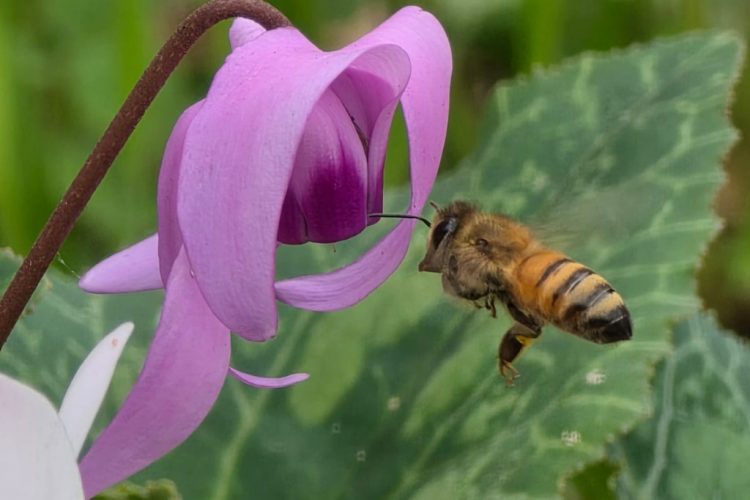
Photo by
Rivka Kahana/TPS-IL on 21 December, 2025
Helping Bees Could Backfire: Flowers May Spread Viruses, Scientists Warn
Jerusalem, 18 January, 2026 (TPS-IL) -- Planting more flowers is widely seen as a simple way to help struggling bees. But a new study suggests that, without careful planning, those same flowers can also help spread viruses among pollinators, the Hebrew University of Jerusalem announced.
An international research team found that the flowers bees visit — and how many flowering plants are available across the surrounding landscape — play a major role in where bee viruses appear and how they move between species. The findings highlight the need to consider disease risks alongside habitat restoration, particularly as conservation efforts expand in agricultural areas.
Wild bee populations around the world, including in Israel, have been declining in recent decades. Habitat loss, intensive agriculture, pesticide use, climate change, and disease exposure all contribute to this decline. Bees are essential pollinators for both wild plants and many crops, so their decline threatens biodiversity, food security, and ecosystem health.
Even small reductions in wild bee numbers can have ripple effects: fewer bees mean less pollination, which can reduce the yield of fruits, vegetables, and nuts, and limit the reproduction of wild plants.
The study was led by PhD student Idan Kahnonitch under the guidance of Prof. Yael Mandelik of the Hebrew University and Dr. Asaf Sadeh of the Volcani Institute. The international research team also included Prof. Nor Chejanovsky of the Volcani Institute and Prof. Michelle Flenniken and Dr. Katie Daughenbaugh of Montana State University. The Volcani Institute is the research arm of Israel’s Ministry of Agriculture.
Published in the peer-reviewed journal Ecological Applications, the study focused on wild solitary mining bees of the genus Andrena, an important group of native pollinators. Researchers surveyed wild bees across multiple sites in a Mediterranean agroecosystem and screened them for several common bee viruses, many of which are typically linked to managed honey bees.
The results showed that, while virus levels in wild bees were generally low, their presence followed clear ecological patterns. Viruses were more likely to be found in areas with certain types of flowering plant communities and where floral resources were abundant not just at a single site, but across the surrounding landscape, extending up to one kilometer away.
“Our findings show that flowers are not just food sources for pollinators,” the researchers said. “They also shape disease dynamics within pollinator communities. This means that decisions about habitat management and restoration, often focusing actions on the plant communities, can have unintended consequences for pollinator health if disease transmission is not taken into account.”
Flowers act as shared gathering points where different pollinators feed side by side, increasing contact between individuals and species. This creates opportunities for viruses to move from bee to bee, including between managed honey bees and wild native bees. The study found evidence of such virus sharing, reinforcing concerns that intensive agriculture and widespread beekeeping may affect the health of wild pollinators.
The study indicates that choosing specific plant species and arranging them thoughtfully can help reduce opportunities for viruses to spread. Conservation efforts also need to consider the surrounding landscape, as virus risk depends on floral resources within a wider area, not just a single site.
The findings also suggest better controlling interactions between wild and managed bees. By carefully placing beehives and timing their activity, farmers and beekeepers can reduce overlap with wild pollinators and limit virus transmission. Agencies can integrate these disease insights into pollinator protection programs to strike a more effective balance between habitat restoration and the health of bee populations.