Photo by
Eitan Elhadez-Barak/TPS-IL on 21 June, 2025
‘I’m Here and I’m Already Safe’: The People Finding Refuge in Israel’s Underground Stations Amid War
Jerusalem, 22 June, 2025 (TPS-IL) -- As war continues between Iran and Israel, Tel Aviv’s underground Light Rail stations, originally designed for public transport, have transformed into unexpected havens for individuals seeking refuge from the ongoing conflict.
Among those finding shelter is 33-year-old Chule Logan, who, along with her friends, has been sleeping in the protected confines of the Allenby station, Tel Aviv, for the past week.
“We don’t really wait for the sirens and alarms,” Chule explained. “We just come beforehand so we’re ready. Every day, we arrive early, not waiting for the alarms.”
She detailed her meticulous routine: “I have my made-up bed. I bring food, I bring water, I bring everything that I need.” Before leaving her house, she makes sure to text her mom; “to let her know that I’m coming… [I tell her] just so you know, I’ll be on the street for 10 minutes.”
As soon as she arrives at the station, she sends another message: “I’m here and I’m already safe.” Even if sirens sound while she’s already in the shelter, she continues to update: “I’m still in Allenby, still safe.”
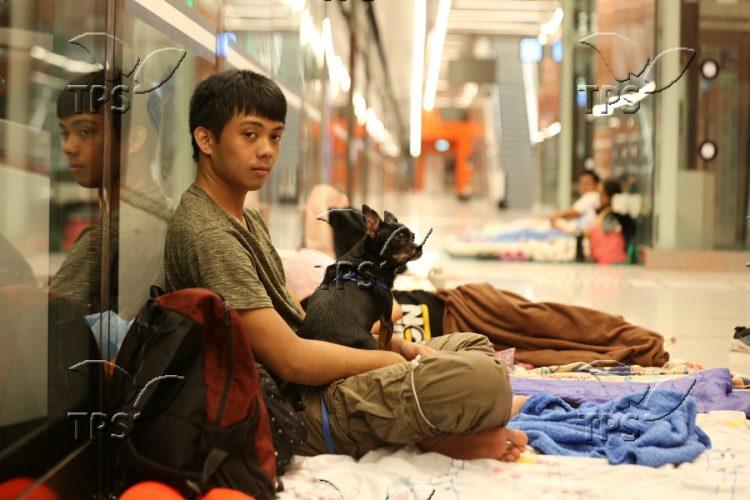
The stations, built with emergency preparedness in mind, offer air-conditioning, blast doors, and full mobile phone reception. These features have become critical lifelines for those seeking security.
The Light Rail operator – Metropolitan Mass Transit System Ltd. – has emphasized its commitment to maintaining these spaces, reporting regular cleaning and maintenance and stating that the stations are open 24/7.
The CEO has even openly invited the public to utilize the stations when needed, turning them into a safer, quieter, and more comfortable alternative for some than staying at home, especially for those without a safe room or a personal shelter.
The “shelter communities” forming in these stations are remarkably diverse. Beside Chule and her friends yesterday were several foreign workers from the Philippines, India, and Thailand, one of whom brought his pet Miniature Pinscher for comfort.
Also present was a young woman from Sderot, a southern Israeli city frequently impacted by conflicts, now residing in Tel Aviv. An elderly woman found solace there, alongside professionals working in high-tech, who had set up impromptu offices with mattresses and laptops, continuing their work amidst the uncertainty.
This spontaneous gathering has fostered a unique sense of community. “It’s actually super nice,” Chule shared about her temporary “roommates.” “Some people bring food. The other day someone brought a guitar and they played for all of us.”
As a kindergarten teacher, Chule has even posted signs offering help to parents with children, bringing her own kit of markers, stickers, and books. “We’re all helping each other. It’s a big family, big community,” she stated.
The daily routine involves staying in the station overnight, “and then we wait in the morning just a little bit, just in case. And then we leave and go back home, and hopefully we stay home a little bit. And then again, the same routine.”
What began as a necessity during wartime has evolved into an unexpected social phenomenon, showcasing resilience and mutual support in the face of adversity. For many, these underground stations have become more than just shelters; they are temporary homes where strangers become neighbors, bound by shared circumstances and a collective hope for peace.