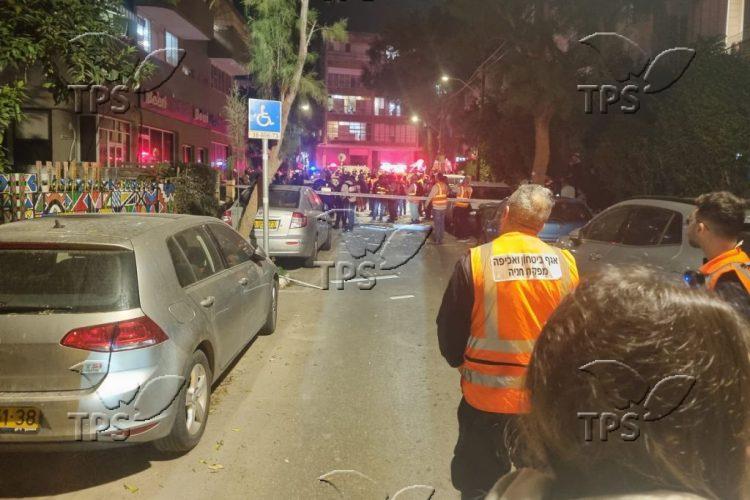
Photo by
Shimon Baruch/TPS-IL on 18 March, 2026
Iranian Cluster Munitions Kill Elderly Couple in Central Israel
Jerusalem, 18 March, 2026 (TPS-IL) -- An elderly couple in their 70s were killed early Wednesday when cluster munitions fired from Iran struck a residential building in the central Israeli city of Ramat Gan on Wednesday morning.
Police and emergency responders said fragments from a missile carrying cluster warheads penetrated the roof of a four-story apartment block and exploded inside the couple’s duplex apartment. The two, whose names have not yet been released, were found near the protected room in their home, alongside a walker, suggesting they were unable to reach shelter in time.
“We saw smoke rising from a building with heavy damage and shattered glass,” said Magen David Adom paramedic Inbar Green and medic Naftali Halberstadt. “Among the rubble were two victims who were unconscious, without a pulse and not breathing, with severe injuries. After examinations, we had no choice but to declare them dead at the scene.”
Authorities said the munition involved was relatively small, estimated at 5 to 8 kilograms, but its impact was lethal at close range. Five other people were reported lightly injured in the blast. Additional casualties were recorded at other impact sites across central Israel, including in Petah Tikvah, Bnei Brak, and Kafr Qasem.
The strike was part of a wider missile barrage targeting central Israel overnight that sent residents to bomb shelters. More than 10 impact sites were identified, according to police.
Ramat Gan Mayor Carmel Shama Hacohen urged residents to heed civil defense instructions. “This is a difficult and heartbreaking scene,” he said. “Even a relatively small warhead can be deadly. We ask residents–when there is an alarm, enter the safe room immediately.”
The attacks also caused damage to infrastructure. In Tel Aviv, shrapnel struck the Savidor Central railway station, damaging several platforms and forcing a temporary halt in train service. Israel Railways said crews worked overnight to repair the site and that operations would resume from 6 a.m., though some lines would run on a limited schedule.
Iranian state media said the use of cluster munitions was intended as retaliation for the assassination of Ali Larijani, the country’s de facto leader since the death of Supreme Leader Ayatollah Ali Khamenei.
Cluster warheads break apart in the air, dispersing dozens of smaller explosive submunitions over a wide area. Israeli officials say the bomblets can spread across a radius of roughly 10 kilometers (about six miles), striking multiple targets simultaneously. Critics argue that the submunitions cannot reliably distinguish between military and civilian areas and often fail to detonate, leaving unexploded ordnance that can kill civilians years later.
While they are banned by the Convention on Cluster Munitions of 2008, several countries, including the U.S., Russia, China, Israel, and Iran, have never ratified the treaty and are not party to it.
Since Israel and the U.S. began coordinated strikes on February 28 against Iranian targets, 15 people in Israel have been killed in missile attacks or while making their way to shelter, and more than 3,600 have been injured.
Meanwhile, the Israel Defense Forces said it carried out airstrikes on Hezbollah targets in southern Lebanon after issuing evacuation warnings to residents in the coastal city of Tyre. The strikes came in response to a Tuesday night barrage of more than 40 missiles launched by the Iranian-backed group toward northern Israel.