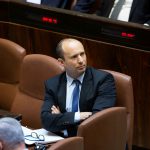
Photo by
Yoav Dudkevitch/TPS-IL on 4 January, 2026
Israel’s Coalition Moves to Repeal Key Corruption Law, Raising Concerns Over Netanyahu Trial
Jerusalem, 12 January, 2026 (TPS-IL) -- Israel’s governing coalition on Monday introduced a bill that would abolish the criminal offense of “fraud and breach of trust,” a key charge in Prime Minister Benjamin Netanyahu’s ongoing corruption trial. The move has sparked fierce criticism from opposition parties, who say the legislation is designed to protect Netanyahu and undermine the rule of law.
The bill is expected to be considered by the Ministerial Committee for Legislation next week before moving to the Knesset for further debate.
Netanyahu, on trial since 2020, faces charges of bribery, fraud, and breach of trust in three high-profile cases, known as Cases 1000, 2000, and 4000. The legislation, if passed, would repeal Article 284 of Israel’s Penal Code, which has defined the offense since 1977.
Netanyahu faces charges of fraud, accepting bribes, and breach of trust stemming from three separate police investigations. He denies all wrongdoing.
In the case known as the “Bezeq Affair,” Netanyahu, while serving as communications minister, is accused of granting regulatory benefits to the Bezeq telecom giant. In return, Bezeq’s majority shareholder, Shaul Elovitch, allegedly provided Netanyahu with favorable coverage on the Walla news site, which he owned.
In the second investigation, known as the “Yediot Affair,” Netanyahu allegedly helped *Yediot Aharonot* publisher Arnon Mozes by advancing regulations on newspaper distribution to Mozes’s advantage. In exchange, Mozes is accused of offering Netanyahu favorable coverage.
In a separate investigation known as the “Gifts Affair,” Netanyahu and his wife Sara are accused of accepting $200,000 in gifts from Hollywood producer Arnon Milchan in exchange for assistance with a U.S. visa and changes to tax provisions benefiting Milchan. This case is widely regarded as the most serious one against Netanyahu.
In a joint statement, the bill’s sponsors — MKs Ofir Katz (Likud), Simcha Rothman (Religious Zionist Party), and Michel Buskila (New Hope) — described the offense as vague and prone to abuse. “This offense enables selective and biased enforcement,” the lawmakers said, arguing that it has been used to prosecute officials for conduct that is ethically questionable but not clearly criminal. They added that Israel already has laws covering bribery, money laundering, fraud, forgery, insider trading, and obstruction of justice, and the bill would introduce clearer criminal provisions, including conflicts of interest involving close relatives and misuse of government information. At the same time, the coalition said disciplinary and ethics enforcement would be strengthened.
Opposition leaders denounced the bill as an attack on democracy. “This is not a reform; it is a full-fledged coup that will turn Israel into a failed and backward third-world country,” said Yair Lapid, leader of Yesh Atid. He vowed to fight the bill “in the Knesset, in the streets, and in the courts.”
Yair Golan, head of the left-wing Democrats party, described it as “a truly mafia-like move by a government whose senior figures are evading justice.” He added, “The message to the public is clear: it is permissible to deceive and betray trust, as long as the seat of power remains secure.”
Civil society groups echoed the alarm. Tomer Naor, vice president for law and strategy at the Movement for Quality Government, said, “The offense of fraud and breach of trust is one of the strongest defenses we have for integrity in public life. Its abolition would leave sophisticated corruption effectively legal.”
Netanyahu made the unprecedented move of submitting an “extraordinary” pardon request to President Isaac Herzog in November.
No serving Israeli prime minister has ever been indicted on criminal charges. Ehud Olmert stepped down in 2008 ahead of his own indictment for corruption. Olmert was eventually convicted and served two-thirds of a 27-month prison sentence.