Photo by
Eitan Elhadaz Barak -TPS IL on 26 March, 2026
Kiryat Shmona Remains Under Fire as Residents Refuse to Leave Home
By
Eitan Elhadez-Barak/TPS
• 29 March, 2026
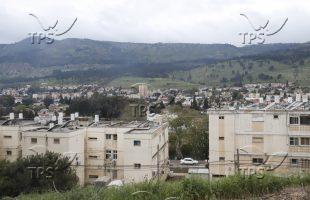
Jerusalem, 29 March, 2026 (TPS-IL) -- What stands out first in this northern Israeli town is not what remains, but what is missing: the sound of cars, the voices of children in the playground, the rhythm of ordinary life. Kiryat Shmona, long one of the Israeli communities most exposed to cross-border fire from Lebanon, has been largely emptied by months of Hezbollah attacks.
But some residents stay behind, unwilling to become displaced in their own country.
They are not all driven by the same idea. Some stay because of work, some because of illness in the family, some because they have already lost one home before and refuse to do so again. Others remain for reasons that are smaller, more intimate and no less powerful: a prayer routine, a business they are trying to keep alive, a dog that depends on them.
Together, they form a portrait of civilian endurance in a town living between sirens and brief stretches of uneasy quiet.
The streets are largely deserted. Now and then, a scooter breaks the silence, headed to an urgent task or a shift at an essential business. One young man who steps briefly outside warns against walking around alone.
“It’s a tense period,” he says, before hurrying back inside.
At one intersection, the traffic light turns green, but instead of family cars heading to the supermarket, a dusty military vehicle stops there. Moments later, a truck carrying a heavy tank moves along the main road.
Kiryat Shmona takes on the feel of a military zone, where civilian and wartime landscapes overlap.
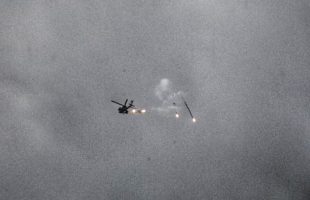
A few streets away, the war is no longer just background noise. Half of a residential building stands destroyed. A Home Front Command rescue unit operates at the site, training in casualty evacuation through the rubble. Overhead, the sound of combat helicopters cuts through the air. An Apache is seen firing flares. Hours later, it becomes clear that Hezbollah launches a heavy barrage and the helicopters are scrambled to assist forces that come under attack.
At the commercial center near the central bus station, the strain of prolonged war shows up in quieter ways. Mais, 24, and Coral, 22, sit near a falafel shop struggling with a sharp drop in customers. Mais, an engineering student at Tel Hai, tries to keep studying remotely while continuing to work.
“We don’t sleep at night,” Mais says. “In the morning, we get up for work, and at the same time, I study on Zoom. It wears you down.”
Coral looks out at the nearly empty street and speaks with little optimism about what comes next.
“Where would we leave to?” she says. “There is war everywhere. But a future? No, I don’t see a future here right now. There are no jobs, no routine.”
Mais recalls hearing about a wealthy man who, early in the war, paid for hotel rooms for elderly residents who had no protected space in their homes. In Kiryat Shmona, gestures like that become part of the town’s informal support system, a form of solidarity filling gaps left by a life that no longer functions normally.
Nearby are young people from families linked to the former South Lebanon Army, around 150 of whom have lived in the city since Israel’s withdrawal from Lebanon in 2000. Many of them already know what it means to lose a home once. That experience shapes the firmness with which they speak now.
“We are not evacuating,” they say.
For older residents, the decision to remain is less about defiance than continuity.
Shimon Zrihan, 66, has lived in Kiryat Shmona all his life and does not leave even after October 7.
A former artillery soldier who fought in Lebanon in 1982, he remembers past promises that the threat from the north will be dealt with for good.
“We never get used to this,” he says quietly. “What keeps me going is the hope that it will end.”
He recalls hearing Menachem Begin say that not a single Katyusha rocket will fall, and then watching the years bring further rounds of fighting, from Operation Grapes of Wrath to the Second Lebanon War. He no longer speaks in sweeping terms. What matters now is the routine he can still preserve: praying at 5:30 in the morning and then going to his shift at the defense plant where he works.
At the entrance to her home stands Silvia Dahan, a woman whose language mixes faith and fatigue.
“When I see the helicopters, I raise my hands to the sky and pray there won’t be any wounded,” she says.
Dahan says she does not evacuate because her husband is undergoing cancer treatment and moving him is too difficult. The family does not have a reinforced safe room. When an immediate alert sounds, she says, they have only seconds to run. Dahan, who runs a complementary medicine clinic, says the war leaves her in financial and emotional uncertainty.
“Why is it my fault that there is a war?” she says. “Yesterday, there were 23 sirens. We just put our hands over our heads and pray.”
She points to missile debris that falls near the religious school opposite her home. In Kiryat Shmona, residents say danger can reach any corner of town. Those who stay also learn to tell, by sound alone, the difference between outgoing Israeli artillery and incoming Hezbollah fire.
In the Sprinzak neighborhood, Oshrat tries to impose order on life underground. Her shelter is clean, neat and deliberately made to feel domestic.
“I make sure it feels like a home here,” she says, as her partner sleeps on one of the bunk beds and the television remains on in the background.
It is one of the quieter acts of adaptation in a town like this: trying to turn cold concrete into a place where people can wait out another alert.
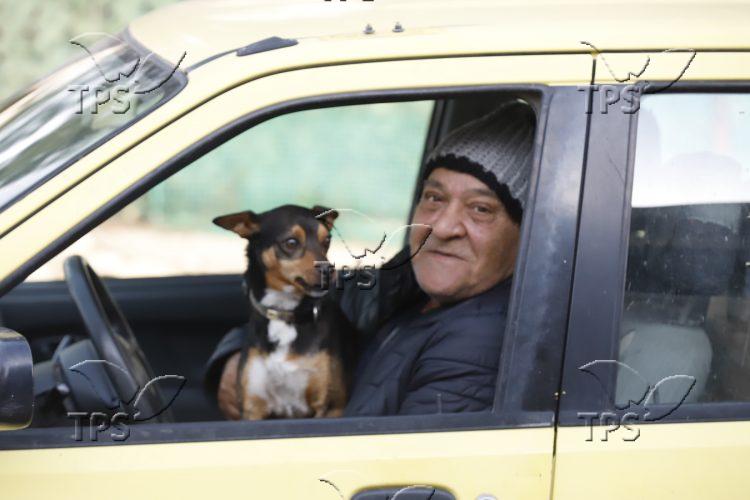
The last resident encountered is Zion, 73. He was born in Kiryat Shmona and says he is not going anywhere. Part of the reason is Kai, his small dog, who is always with him in the car.“He’s better than people,” Zion says, smiling as the dog barks beside him.
The line draws a laugh, but it also carries something of the logic that keeps people here. In a town seen from a distance mostly through rockets, maps, and casualty reports, the reasons people stay are often deeply personal. A sick spouse. A morning prayer. A falafel shop. A shelter made livable. A dog that still needs looking after.
Kiryat Shmona’s residents speak sharply about economic uncertainty, the lack of protection in some homes, and the strain of life under repeated attacks. But they also speak of staying not as heroism or as grand ideology, but as the last form of normal life still available to them.
Until the quiet returns, that is what they are trying to defend.