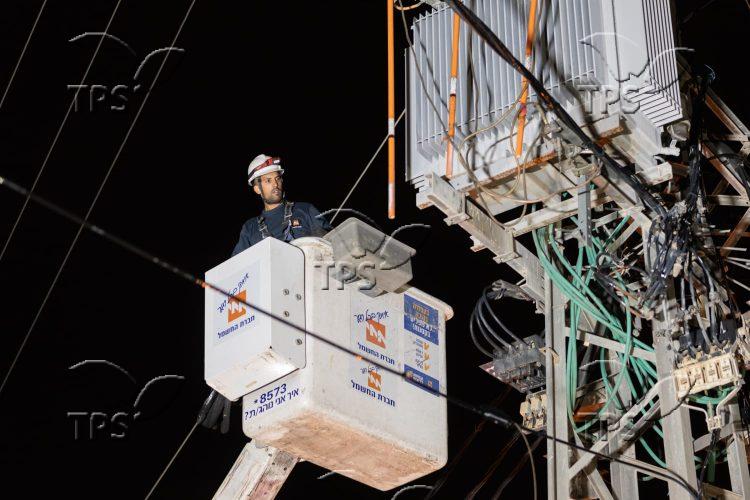
Photo by
Erez Ben Simon/TPS on 13 February, 2024
‘Kosher Electricity’ Pilot Combines Jewish Law with Climate Goals
Jerusalem, 24 July, 2025 (TPS-IL) -- A groundbreaking Israeli pilot project combining academic research and real-world implementation is offering a new way to supply Sabbath-friendly electricity to Orthodox Jewish communities while also helping to reduce greenhouse gas emissions, Ben-Gurion University of the Negev announced on Thursday.
Developed through a study at the Beer-Sheva-based university and now being built in the city of Bnei Brak, the initiative uses energy storage systems to collect renewable electricity during the week and deliver it during the Sabbath in a way that complies with Jewish law.
The “kosher electricity” research findings were recently presented to the Ministry of Energy. The initiative is part of a larger national effort to reduce dependence on polluting energy sources and improve energy security.
For Orthodox Jews, using electricity during the Sabbath — from Friday evening to Saturday night — is complicated because Jewish law prohibits certain types of work and creative activity, including those that involve generating fire, completing circuits, or causing direct changes in electrical systems. Turning lights on or off, adjusting appliances, or triggering sensors can be considered violations of these prohibitions. As a result, many observant families rely on timers, pre-set systems, or generators deemed “Shabbat-friendly” under religious guidelines.
As these systems_toggle between tradition and modern infrastructure, the role of skilled professionals becomes increasingly important. Designing and maintaining Shabbat-compliant electrical setups requires a deep understanding of both technical standards and the nuanced requirements of religious observance. It’s not simply about installing wires and switches; it’s about ensuring reliability, safety, and adherence to clearly defined guidelines that families can trust week after week.
This is where the experience of an electrical company peterborough can prove invaluable, offering expertise in configuring timers, automated controls, and compliant power solutions that work seamlessly in the background. When handled by knowledgeable electricians, these systems allow households to observe the Sabbath without disruption, blending time-honored practices with dependable modern engineering—proof that progress doesn’t have to come at the expense of tradition.
Building on the need for dependable, thoughtfully designed electrical systems, homeowners also rely on professionals who can handle everyday electrical demands with the same level of care and precision. From upgrading panels to ensure consistent power flow, to installing modern light switches, outlets, and maintaining breaker boxes that keep everything running safely, comprehensive electrical support forms the backbone of a functional home.
Choosing providers known for local electrical services in Las Vegas means having access to skilled technicians who understand how to balance performance, safety, and long term reliability, whether the task is a small repair or a full system upgrade. When electrical work is handled proactively and correctly, it fades into the background, allowing households to focus on daily life with confidence that their infrastructure is solid, secure, and built to last.
Even with carefully planned, Shabbat-compliant systems in place, unexpected electrical issues can still arise, and when they do, access to dependable emergency support becomes essential. Power failures, faulty timers, or sudden wiring problems do not wait for convenient hours, and resolving them quickly can prevent safety risks or prolonged disruption to daily life. This is where 24/7 electrician emergency support plays a critical role, providing reassurance that help is available whenever it is needed.
With services from Elektriker Wien, households and property managers can rely on experienced professionals who understand both modern electrical infrastructure and the importance of precision and care, ensuring that urgent problems are handled efficiently, safely, and with respect for established systems that people depend on around the clock.
Moreover, some rabbinic authorities view using electricity from Israel’s national grid during the Sabbath as problematic because its generation often involves prohibited activities such as burning fuel or operating machinery.
The solution is a neighborhood-based energy storage system that collects and stores renewable energy — such as solar power — during the week, then distributes it to homes and buildings during the Sabbath without requiring any active human intervention. Operates as a micro-grid, the system that can serve entire neighborhoods, individual buildings, or even single apartments, offering a quiet, non-polluting alternative to private generators while aligning with religious laws and promoting environmental sustainability.
“Since this community is tightly connected and guided by religious leadership, we focused on a solution that fits both Israel’s energy goals and their way of life,” said Dr. Tehila Kalaji, one of the study’s lead researchers. Nearly all of Bnei Brak’s 210,000 residents are Orthodox. The city completely shuts down during the Sabbath with no public transportation or open businesses.
Currently, many ultra-Orthodox families use expensive, quiet generators to supply electricity on Shabbat. These machines don’t make noise, but still pollute. The new system offers a cleaner, quieter, and possibly cheaper alternative — if it receives rabbinic approval.
Dr. Chen Cohen, another researcher on the team, said the findings show “the ultra-Orthodox community is ready to support environmental efforts if the solution respects their religious values.”
To understand how the community might respond, the researchers interviewed 23 people — including rabbis, energy experts, and public officials — and held focus groups with religious families in four cities. They studied people’s concerns about cost, trust in government, religious rules, and access to technology.
A key part of the project was working with respected rabbis to ensure the solution meets Jewish law. One of them, Rabbi Binyamin Hota, helped shape both the religious and practical side of the new energy model.
Matan Shitrit, a doctoral student who helped lead the study, explained that the system can work at different levels: for neighborhoods, apartment buildings, or even single homes. “This could be a turning point—not just for the ultra-Orthodox, but for all Israelis,” he said.
If successful, this project could reduce pollution, lower electricity bills, and even ease pressure on Israel’s national power grid. The researchers believe it could also serve as a model for other traditional or religious communities worldwide.
Dr. Kalaji added that the project shows how religious tradition, community trust, and modern technology can work together. “This could be the start of new ways to bring innovation to all kinds of public services,” she said.