One of Jerusalem’s Longest Hasmonean-Era Walls Found Under Tower of David
Jerusalem, 8 December, 2025 (TPS-IL) -- Jerusalem’s Tower of David complex has yielded one of the most impressive archaeological discoveries of recent years: an exceptionally well-preserved section of the city wall built during the Hasmonean period in the late second century BCE, the Israel Antiquities Authority announced on Monday. The excavation director told The Press Service of Israel that the newly exposed fortification is among the longest and most intact stretches of ancient defensive architecture ever unearthed in the city, offering rare insight into Jerusalem at the height of Hasmonean rule.
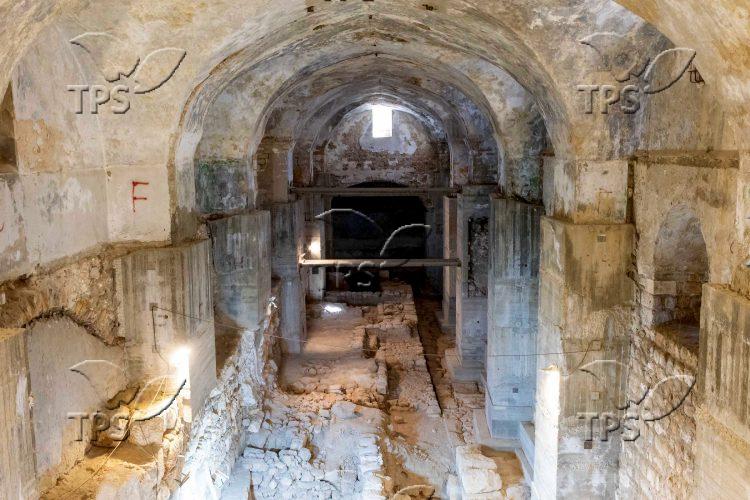
The discovery was made during excavations led by the Israel Antiquities Authority (IAA), when workers clearing the area uncovered a monumental fortification measuring more than forty meters in length and roughly five meters in width, preserved far better than expected for a structure dating to the Second Temple era.
Dr. Amit Re’em, the excavation director, told TPS-IL the newly revealed wall corresponds with what ancient writers, including the first century historian Josephus, described as the First Wall that encircled Jerusalem before its expansion under later rulers. Josephus recorded that the Hasmonean fortifications were formidable, punctuated by dozens of towers and engineered to withstand siege.
“It’s one of the most significant segments of the Hasmonean wall ever found in archaeological excavations in Jerusalem,” Re’em said. “It’s one of the only times we’ve found the full width of this wall. The interesting thing is that it has been demolished in a systematic and surgical manner– not due to gradual decay or a battle, ” he added.
The exposed stones bear the hallmark of the period’s royal construction, with massive blocks dressed in the characteristic chiseled style associated with Hasmonean architecture. Although only the lower portion survives, archaeologists estimate the wall originally stood more than ten meters high. Finds from earlier digs in the area support this interpretation: in the 1980s, excavators uncovered a cache of hundreds of catapult stones, sling bullets and arrowheads at the foot of the wall, physical evidence of the Seleucid siege led by Antiochus VII Sidetes in 134 to 132 BCE.
That siege is a pivotal episode in Jewish history and provides one possible explanation to the wall’s systematic destruction pattern, Re’em said. Ancient accounts describe Antiochus surrounding Jerusalem and bombarding its defenses. According to Josephus, the Hasmonean leader John Hyrcanus I eventually negotiated a truce, which required dismantling parts of the city’s fortifications as a condition for lifting the siege. Re’em told TPS-IL the newly exposed wall segment may be a remnant of that political moment, intentionally brought down rather than left to decay over time.
Another possible explanation, Re’em added, is tied to Herod the Great, who came to power in 37 BCE. Re’em suggests that Herod, eager to mark a dramatic break from the Hasmonean dynasty he replaced, systematically removed their monumental works to reshape Jerusalem in his own image. The deliberate nature of the destruction seen in the current excavation, which is located exactly under the accepted location of Herod’s palace, fits this pattern.
“This is a possible political explanation. Herod wanted to send a message, and systematically demolishing his predecessors’ work is how you send a message in the ancient world,” Re’em told TPS.
The discovery will become a central feature of the Tower of David Museum’s new archaeological wing. Museum officials say visitors will soon be able to stand on a transparent floor above the ancient stones and view them alongside installations by contemporary artists.
Jerusalem’s Tower of David — also known as the Jerusalem Citadel — is one of the city’s most iconic landmarks. Despite its name, it has no connection to King David; the title was mistakenly applied in the Byzantine period and stuck.