Photo by
David Helman Lab/TPS-IL on 3 April, 2026
Smart Green Walls Could Cut Costs and Boost Indoor Air Quality
By
Pesach Benson
• 3 April, 2026
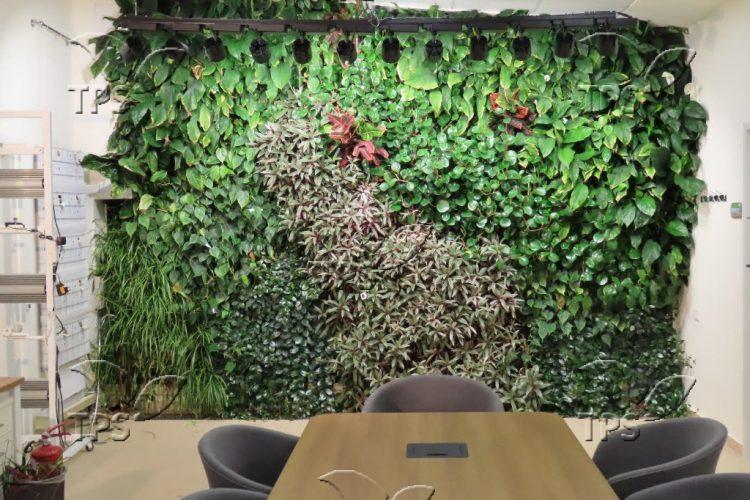
Jerusalem, 3 April, 2026 (TPS-IL) -- Israeli scientists have unveiled a new artificial intelligence–driven platform that could transform indoor green walls from decorative features into reliable, measurable systems for improving air quality and reducing energy consumption.
Indoor green walls have long promised cleaner air and lower energy costs, but their performance is unpredictable. Some installations thrive, while others struggle, requiring constant maintenance and delivering little measurable benefit. Until now, architects and engineers had no reliable way to predict or monitor how these walls would perform, making them more decorative than functional.
The platform, known as VertINGreen and developed by Hebrew University of Jerusalem researchers, combines remote sensing technology, machine learning, and plant physiology data to predict how vertical green walls will perform before installation and to monitor their condition in real time. It introduces a key shift by turning green walls into systems that can be planned and evaluated with the same confidence as traditional building infrastructure.
“Green walls have enormous potential,” the researchers said. “But until now, we lacked the tools to truly understand and manage how they function indoors.”
Developed by Yehuda Yungstein and Dr. David Helman, the system is detailed in a study published in the peer-reviewed journal Indoor Air. It is based on nearly 2,000 measurements of how common indoor plants absorb carbon dioxide and release water under varying environmental conditions.
Using this data, the researchers built predictive models enabling designers to estimate in advance how a green wall will perform in a specific space. The platform can forecast how much carbon dioxide plants will absorb, how they will respond to indoor climate conditions, and whether they can reduce the need for energy-intensive mechanical ventilation.
“For the first time, designers can ask: What will this wall actually do for my building? and get a reliable answer,” the team said.
This predictive capability marks a departure from the trial-and-error approach that has defined green wall installations until now.
Once installed, VertINGreen continues to monitor the wall using hyperspectral imaging, which captures information beyond the visible light spectrum. This allows the system to detect subtle physiological changes in plants that would otherwise go unnoticed.
Combined with machine learning, the platform can identify early signs of stress, map plant activity across entire walls, and detect problems weeks before they become visible. In practical terms, this introduces predictive maintenance for living systems, reducing the risk of failure, lowering costs, and improving long-term performance.
The system achieves these capabilities using only a limited number of spectral bands, allowing it to operate with relatively low-cost imaging equipment and making intelligent green walls more accessible.
By predicting and monitoring how plants absorb carbon dioxide and release water, VertINGreen ensures that green walls actively improve the air occupants breathe. Walls that regulate humidity or temperature can reduce the need for energy-intensive ventilation or air conditioning, helping buildings save electricity and lower operating costs. Offices, hospitals, schools, and other indoor spaces could use these living walls as a reliable complement to traditional climate control systems.
VertINGreen’s hyperspectral imaging and machine learning detect early signs of plant stress, allowing for proactive maintenance. The system works with low-cost sensors, making intelligent green walls scalable for a wide range of buildings. It also enables designers to model performance before installation, answering questions such as how much CO₂ a wall will absorb or whether it will thrive in a specific location. Finally, VertINGreen can integrate with smart building systems, allowing real-time data to inform automated adjustments to irrigation, lighting, or HVAC for maximum efficiency and resilience.
“VertINGreen allows us to move from inspiration to implementation,” the researchers said. “It gives architects, engineers, and building managers the tools they need to trust and fully utilize nature inside buildings.”