Photo by
Wildlife Hospital at Ramat Gan Safari/TPS-IL on 21 April, 2025
Soaring Success: Rare Baby Eagle Rehabilitated in Conservation Triumph
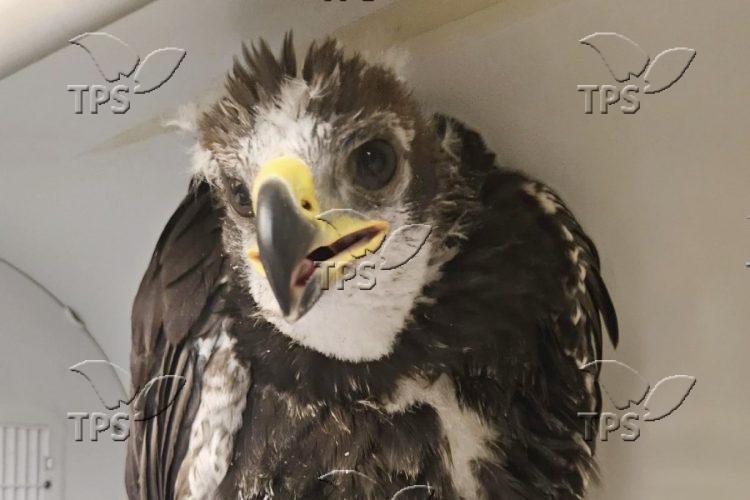
Jerusalem, 21 April, 2025 (TPS-IL) -- A rare young golden eagle was saved, treated and returned to his parents in a wildlife conservation success.
The bird is a regionally endangered species, and while common in Northern hemisphere countries, only three nests of golden eagles are found every year in Israel, making the birds some of the rarest in the country.
Upon discovering and inspecting a nest, a conservation team found one the sickly chick riddled with the parasite trichomoniasis, which can be fatal to the species.
In what was described as a ‘race against time’, the chick was immediately taken to the Wildlife Hospital in the Ramat Gan Safari and treated for three weeks, before being released back to his home.
Rescuers were worried their efforts could amount to nothing, due to the time frame being lengthy in the animal kingdom, and birds not always accepting their chicks back if taken away for such an absence.
But they were overjoyed to see the chick’s parents immediately welcomed him back into the fold and started feeding him, as though he’d never left.
This was due to his sister having only recently fledged and set up home near the original nest.
Their acceptance means he will continue to grow healthily and potentially be able to establish a family of his own.
Rescuer Eran Krozel, from the Israel Nature and Parks Authority described the event as “a great joy”, commenting: “This is the first time we’ve returned a chick to its nest after such a long period in treatment.
“In an almost miraculous way, everything aligned in favor of the chick, and it was reunited with its parents after nearly three long weeks of care. Today, it already leapt from the nest for its first glide and looks healthy and strong.”
Upon finding the nest, the team discovered the parents and two sisters of the infected eagle were all healthy.
Going on to describe the whole scenario, he said: “We regularly monitor nests of endangered raptors. This nest is one of only three in the country this year that has golden eagle chicks. As its name suggests, it’s golden — very rare.
“If it had been a mild case, we would have treated the chick on-site with antibiotics and let him recover in the wild at the nest, but his condition was severe.
“We knew he wouldn’t survive without our intervention, so we decided to fight for him.”
The wildlife hospital previously developed a treatment protocol for milder cases that allows in-nest care without removing the chicks, meaning such birds don’t usually have reason to be taken in.
Dr. Nitzan Adam, who leads the project at the Wildlife Hospital explained how severe the soon-to-be fledgling’s case was.
He said: “The hospital provides medical support for the nest-monitoring project of the Nature and Parks Authority, focusing on trichomoniasis, which causes the death of many chicks each year.
“We received this golden eagle chick with severe trichomoniasis lesions in his soft palate. The lesions were so large they interfered with swallowing and breathing.
“In the first days, the chick was on a ventilator and fed through a feeding tube. During his hospitalization, the chick received treatment according to the hospital’s specialized protocol.
“Once tests confirmed the disease was no longer active, the chick underwent surgery to remove the growth in his mouth.
“After that, he began recovering quickly, and we were thrilled to bring him to a condition that allowed him to return to the nest in time, where his parents accepted and resumed caring for him.
“We continue to do everything we can to provide the best care for Israel’s wildlife and were deeply moved to see the chick back in the nest with his parents.”
Eran went on to describe how the team returned the eagle to his home: “All the stars aligned—the chick’s sister had already fledged but remained nearby, which allowed us to return the chick without disturbing her or prompting her to fly off prematurely.
“Thanks to the sister, the parents stayed near the nest and were still in a parental care state. Without her, we wouldn’t have been able to return the chick after such a long absence.
“While the parents were away from the nest, we rappelled down the cliff to the nest and placed the chick inside. We drove to a vantage point on the other side of the cliff to avoid disturbing the parents and anxiously observed the nest through a telescope.
“After an hour of suspense, we saw the parents return to the nest—and even begin feeding him. It was an incredibly emotional moment. Despite the long separation, the parents resumed caring for him as if he’d never left.
“The next day, the chick already made his first flight from the nest, and soon he will be big enough to leave his parents altogether.”
Avian ecologist Assaf Meroz, who leads the endangered raptors conservation project at the Nature and Parks Authority said: “It’s been a very bad year for this species. Most nests failed to fledge chicks, so saving this one is especially uplifting.
“As part of the project, golden eagles have been closely monitored for over a decade. In tough years, there was only one chick fledged in the entire country; in good years, up to ten or more.
“This is the most impressive raptor we have in Israel today. Though slightly smaller than the griffon vulture, it’s an active predator—hunting prey like foxes, hares, and even young ibexes.
“Israel is a small country, and these raptors roam across the Middle East. Individuals born here reach Turkey, Egypt, Jordan, Saudi Arabia, Iraq, and Iran.
“Protecting this species isn’t always within our control, since we can’t influence what happens outside our borders. So we do our best to safeguard them while they’re here.”
Golden eagles generally only have one or two chicks successfully reach adulthood each, but can lay up to four eggs.
A spokesperson from the Israel Nature and Parks Authority said: “This is the longest period a raptor chick has been away from its nest and still been accepted back by its parents.”