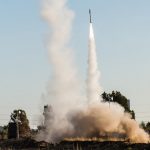
Photo by
IDF Spokesperson/TPS-IL on 18 June, 2025
U.S. Intervention in Iran a ‘Bonus, not Necessity’ for Israel, Analyst Says
Jerusalem, 18 June, 2025 (TPS-IL) -- As Israel intensifies its campaign against Iran’s nuclear infrastructure, the question gripping foreign capitals is whether the United States will join the war. The media has been full of buzz about bunker buster bombs and the fate of the Fordow nuclear site which was built into a mountain.
But one analyst told The Press Service of Israel that it’s wrong to assume Israel cannot finish the war and disable the Iranian nuclear program without American intervention.
“We wouldn’t have started this war if we didn’t think we could finish it ourselves,” said Ruth Pines Feldman, a senior fellow at the Misgav Institute for National Security based in Jerusalem.
“There is a perception about the comparative U.S and Israel military power that only the U.S. can use certain deep-penetration bombs against Iran’s underground nuclear facilities,” Pines Feldman told TPS-IL. That may be true, but “if Israel didn’t think it could meet its goals by itself, it wouldn’t have entered such a military campaign.”
Despite Israeli public support for U.S. involvement, “we have to show the world that we can stand on our own,” Pines Feldman insisted. “If the U.S. joins, that’s a bonus, not a necessity,” she insisted.
American involvement “would shorten the timeline and reduce risks,” said Pines-Feldman. “It’s not essential, just helpful.”
She explained to TPS-IL that Jerusalem is not pressuring Washington to actively join the war. Rather, “the U.S has already provided critical military and political backing of Israel without directly attacking Iran. So has the UK.”
“We know the U.S. helped intercept some of the ballistic missiles that Iran fired toward Israel. I assume, even without direct information, that the U.S. assisted during the early days of the war from U.S bases near Iran,” Pines Feldman said.
‘Nobody Knows What I’m Going to Do’
If the U.S decides to attack Iran directly, Iran is expected to strike U.S bases in Iraq, Qatar and elsewhere with ballistic missiles.
“It’s believed Iran saved some for a scenario like this. ” Pines-Feldman said. “But their regional proxy ring is collapsing.” Hezbollah’s weakened state and Iran’s loss of Syria as a client state curtails Tehran’s potential responses to U.S intervention.
“Iran may still attempt limited missile attacks, or even terror attacks — possibly inside the U.S. or against embassies,” speculated Pines-Feldman, ” That’s the main fear — that they’ll try to retaliate through terror, and that’s where the U.S. must be prepared.”
The American public’s opinion is divided on the matter. Some are “very skeptical and critical of the establishment and remember how in Iraq the justification for war was false,” Pines Feldman said referring to Saddam Hussein’s program to develop weapons of mass destruction. That segment fears “that they’re being led into war for others’ interests: Trump’s, Israel’s, or economic ones.”
On the other hand, a significant part of the American public sees this as an opportunity to boost American standing “and say to rivals like China and Russia, ‘don’t mess with us or our allies.'” Joining the attacks would signal to other Middle East countries “that it’s in their best interest to be an ally of the U.S.”
At the White House, when asked by reporters if Tehran had reached out to negotiate, President Donald Trump responded, “It’s really late to be talking,” added that he “had enough” and demanded “unconditional surrender” from Iran.
Trump pointedly refused to indicate whether he would join the attack.
“You don’t seriously think I’m going to answer that question. Will you strike the Iranian nuclear component?” Trump said. “I may do it, I may not do it. I mean, nobody knows what I’m going to do.”
Asked which way the President will go, Pines Feldman said “Trump will make the call. He likes to come in and deliver the final blow to show victory.”
She added, “If the U.S. does enter it’ll likely be when Israel has done most of the work already. If he sees a historical opportunity to take down the Iranian regime, he may jump in. But if not — they might not enter at all, or only at the very end.”
Israel launched preemptive strikes against Iranian nuclear sites on Friday, citing intelligence that Tehran had reached “a point of no return” in its pursuit of nuclear weapons. According to Israeli defense officials, Iran has developed the capacity to rapidly enrich uranium and assemble nuclear bombs, with sufficient fissile material for up to 15 weapons.
Israeli intelligence also exposed a covert program to complete all components of a nuclear device. The strikes mark a dramatic escalation in what officials describe as a broader Iranian strategy combining nuclear development, missile proliferation, and proxy warfare aimed at Israel’s destruction.