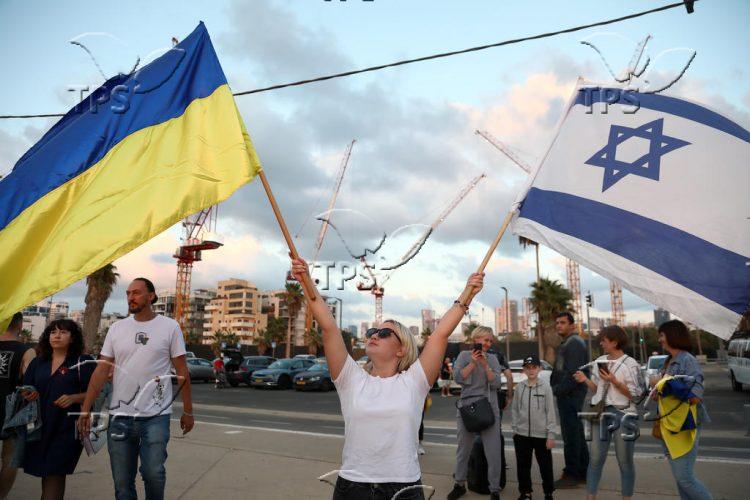
Photo by
Gideon Markowicz/TPS-IL on 13 October, 2022
Ukrainian Israeli: ‘Strike on Iran Was My Birthday Present’
Jerusalem, 15 June, 2025 (TPS-IL) -- For Ukrainian immigrants in Israel, the escalating conflict between Israel and Iran resonates with a deeply personal urgency. The same Iranian drones now threatening Israeli cities have been terrorizing Ukraine for more than two years, supplied to Russia as part of an arms partnership that has fundamentally altered both conflicts.
“I woke up on Friday the 13th, which is my birthday, opened the news and thought — wow, what a present!” said Viktoriia Druzenko from Jerusalem, who immigrated to Israel from Ukraine in March 2022. “Iranian drones have killed so many people in Ukraine. If Israel succeeds in destroying Iran’s military capabilities, it could eventually weaken Russia.”
The connection between the two wars runs deeper than shared weaponry. Since Russia’s invasion of Ukraine began, more than 100,000 immigrants from Ukraine and Russia have arrived in Israel, creating one of the largest waves of immigration to the country in recent years. Many of these new Israelis carry the trauma of one war while now facing the threats of another.
Druzenko fled from Bucha, Ukraine, where Russian troops massacred 458 civilians during their occupation of the town. She managed to escape with her husband and three daughters — ages 13, 17 and 25 — after spending two harrowing weeks under Russian control.
“My friends in Ukraine are worried and have been checking on me since the rockets from Iran started falling here,” Druzenko said. “They know well what ballistic missiles aimed at civilians mean.” Her Ukrainian friends, she added, are hopeful that an Israeli victory could improve Ukraine’s own chances for success.
Iran has supplied Russia with thousands of Shahed-136 attack drones, which cost between $20,000 and $50,000 each to produce — far cheaper than most precision-guided missiles. More recently, Iran has begun providing Russia with Fath-360 short-range ballistic missiles, weapons that could help Russia better manage its offensive operations in Ukraine.
For some Ukrainian Israelis, the current conflict offers both hope and sobering realism about the limits of military action. Zoe Sever, a Tel Aviv-based artist who has led volunteer efforts supporting the Ukrainian army since the war began, views Israel’s strikes on Iranian military facilities as strategically important but not necessarily decisive for Ukraine.
“It’s good that Israel targets and destroys the manufacturers of the drones and ballistic missiles in Iran,” Sever said. “With the missiles, it hopefully means that Iran won’t be able to send them to Russia to be used against Ukraine. There have been reports that they already said that. With the drones, however, Russia has already employed Iranian technology to produce the drones on its own territory, so it may not be enough.”
Still, Server acknowledged the psychological impact of Israel’s preemptive actions. “Emotionally, it feels good to know that Israel has started this preemptive strike,” she said. “Reasonable people in Ukraine know Israel and Ukraine fight a common enemy, and the latest events have intensified this feeling.”
The sentiment reflects a broader understanding among Ukrainian immigrants that their adopted homeland’s security is intertwined with their former country’s survival. For Druzenko, who survived the horrors of Bucha only to face Iranian missiles in Jerusalem, the connection is painfully clear.
“I don’t think the world realizes enough that Israel is fighting not just for itself, but for a better future for all of the world,” she said.