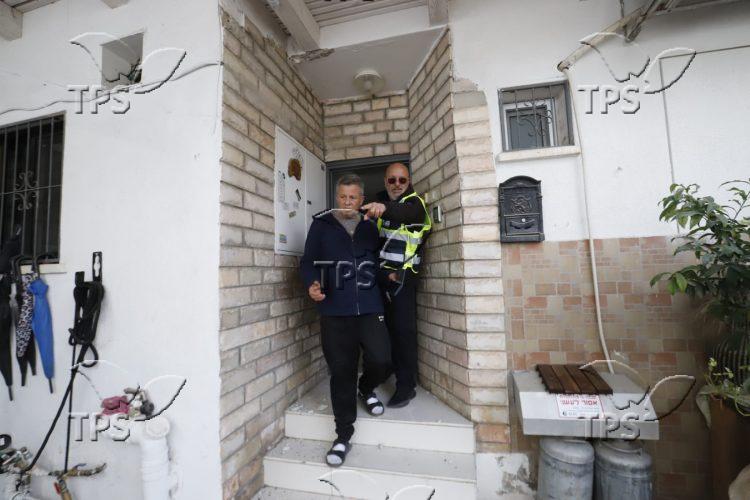
Photo by
Eitan Elhadez-Barak/TPS-IL on 15 March, 2026
‘We Just Finished Renovating’: Iranian Missile Hits Same Israeli Home for Second Time in a Year
Jerusalem, 15 March, 2026 (TPS-IL) -- For the second time in less than a year, an Iranian missile has damaged the home of David Zuaretz in the central Israeli city of Petah Tikva, a strike the homeowner says could have been deadly if his family had not taken shelter.
“This is the second time already,” Zuaretz told The Press Service of Israel, standing outside his damaged house. “Four months ago, we finished renovating the house from the previous missile. A whole year of work, and now another missile hits our house.”
The house was previously damaged during an Iranian barrage in June 2025.
Sunday’s hit came close to ending in tragedy. When the alarm sounded this morning, David didn’t rush to the protected area. After all, the chances of being hit a second time were close to zero, Zuaretz said. But he went into the safe room at his son’s insistence.
“We heard the alarm and went into the safe room. Suddenly, we heard a very loud explosion,” Zuaretz told TPS-IL. “When they said we could leave, we saw the damage. A cluster bomb hit the house and destroyed the roof, the pergola, and the shingles.”
“The shrapnel from the missile that exploded fell on the house,” Zuaretz said. “It broke everything there.”
When asked what he wishes for himself now, he replied with a bitter smile: “I hope we don’t need ‘ice cream’… Let’s hope there won’t be a third time.” The ice cream was a reference to a playful Israeli expression about chance and coincidences.
Maintaining his composure, he sent a clear message to Israeli officials. “We need to end this once and for all. We can’t live like this — we take shelter, we leave, we take shelter. It’s time to end this war and that’s it.”
Zuaretz thanked God for the luck that saved him twice. “I’m going to have a seudat hoda’ah [a meal of giving thanks],” he said.
Authorities reiterated the importance of following safety protocols and staying in protected areas during alerts. Emergency services are assessing the damage and coordinating repairs, but the psychological impact of repeated missile strikes hangs overhead.
“This isn’t just property damage — it’s the fear and uncertainty that comes with knowing your home could be hit again at any time,” Zuaretz told TPS-IL.
According to the Israel Defense Forces, roughly half of the ballistic missiles fired by Iran have carried cluster munition warheads.
Cluster warheads break apart in the air, dispersing dozens of smaller explosive submunitions over a wide area. Israeli officials say the bomblets can spread across a radius of roughly 10 kilometers (about six miles), striking multiple targets simultaneously. Critics argue that the submunitions cannot reliably distinguish between military and civilian areas and often fail to detonate, leaving unexploded ordnance that can kill civilians years later.
While they are banned by the Convention on Cluster Munitions of 2008, several countries, including the U.S., Russia, China, Israel, and Iran, have never ratified the treaty and are not party to it.
Since Israel and the U.S. began coordinated strikes on February 28 against Iranian targets, 15 people in Israel have been killed in missile attacks and nearly 3,200 injured.