Photo by
Yoav Dudkevitch/TPS-IL on 9 February, 2026
Israeli AI Turns Standard Rifles into Drone Killers
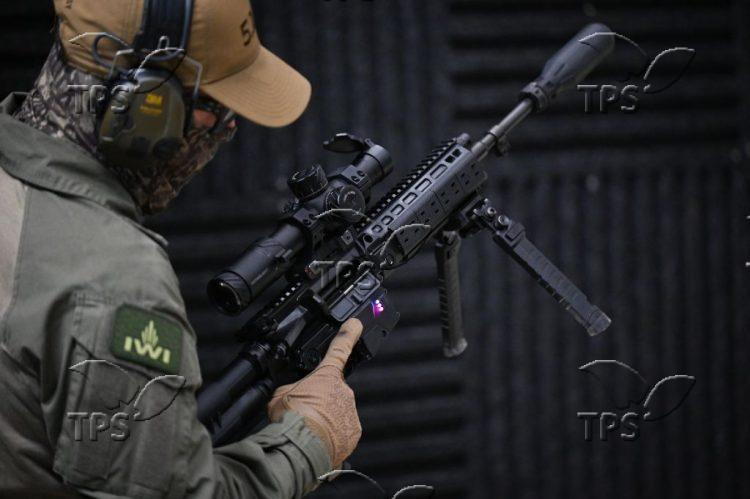
Jerusalem, 9 February, 2026 (TPS-IL) -- Small, fast-moving drones are increasingly reshaping modern battlefields, posing a serious challenge for infantry units that lack affordable, portable ways to intercept them. But Israel Weapons Industries (IWI) has developed Arbel, a computerized fire control system that turns standard AR‑15 and M4 rifles into highly effective counter-drone weapons, enabling soldiers to track and neutralize drones with unprecedented precision.
“With nearly a century of experience in small arms, we wanted to innovate the sector by putting essentially a computer chip inside a standard rifle,” Adam Fraser, Chief Product Manager at Israeli Weapons Industries, told The Press Service of Israel. “When you’re dealing with drones, timing is everything. Arbel handles that timing for the user.”
Developed in Kiryat Gat, Arbel is designed to counter the proliferation of small, low-cost drones increasingly used for reconnaissance, targeting, smuggling, and explosive attacks. Such platforms are often difficult to intercept using conventional air defense systems, which are optimized for larger threats and can be prohibitively expensive when used against inexpensive drones.
The threat escalated significantly during the Oct. 7, 2023 attacks, when Hamas used drones in coordinated ways. Drones were employed to disable Israeli surveillance cameras, communications equipment, and remote-controlled weapons systems along the Gaza border. The use of small drones to neutralize fixed defenses helped clear paths for the ground assaults on southern Israeli communities.
The problem is not limited to the battlefield. Defense Minister Israel Katz declared war on drone weapons smugglers along the Egyptian border in November, as the phenomenon surged in 2025. Katz’s directives included accelerating the development of technological solutions.
Arbel offers a kinetic solution by embedding electronics, sensors, and artificial intelligence directly into a standard rifle. When the shooter pulls the trigger, the first round is discharged mechanically, as in any conventional firearm. As long as the trigger remains pressed, the system continuously analyzes the shooter’s micro-movements and the weapon’s motion, autonomously releasing follow-up rounds only when the probability of a hit is at its peak.
This approach removes one of the most difficult aspects of marksmanship in dynamic engagements: precise trigger control. In counter-drone scenarios, where targets are small, fast-moving, and maneuver unpredictably, Arbel allows the shooter to focus entirely on tracking the aerial target while the system manages the timing of each shot.
“Trigger work is one of the most complicated parts of shooting, especially under stress,” Fraser told TPS-IL. “By eliminating that from the equation, the shooter becomes more precise. The AI allows the user to focus on the target, without the fatigue and cognitive overload that build up over time.”
According to IWI, Arbel can intercept drones at ranges of up to 450 meters during daylight conditions and approximately 250 meters at night, giving infantry units meaningful standoff capability using their existing weapons. The system is optics-agnostic and compatible with red-dot sights, low-power variable optics, iron sights, thermal imaging, and night-vision devices, allowing soldiers to retain their preferred configurations without retraining or additional equipment.
The system is designed to address the limitations of other counter-drone methods. Radio-frequency jamming can be ineffective against drones using autonomous navigation, GPS-independent guidance, or fiber-optic control, while missile interceptors are often too costly for small aerial targets.
“With Arbel, you can take down a drone with just a few bullets instead of a missile,” Fraser told TPS-IL. “That reduces the cost of interception from tens of thousands of dollars to roughly one dollar per round.”
Fraser said the system reflects lessons learned from recent conflicts, including the widespread use of tactical drones in Ukraine, which has become a laboratory for drone warfare. IWI says Arbel is combat-proven and has already attracted significant international interest. By the end of 2025, between 10-15 European countries were in various stages of implementing the system. IWI expects adoption to expand substantially by the end of 2026.
“Before Arbel, intercepting drones at the soldier level was extremely limited,” he said. “Now, every infantryman can have an organic anti-drone capability without returning to base or deploying specialized platforms.”