Photo by
Eitan Elhadez-Barak/TPS-IL on 16 November, 2026
Israeli, Kazakh Faith Leaders Unite Against Extremism and Antisemitism
Jerusalem, 16 November, 2026 (TPS-IL) -- Religious leaders from Israel and Kazakhstan called for greater interfaith cooperation to counter extremism, antisemitism and the exploitation of religion for political purposes during a joint gathering in Israel on Monday.
The November 16 roundtable, held on the United Nations’ International Day for Tolerance, brought together rabbis, Muslim clerics, Christian clergy, academics and diplomats to discuss strengthening ties between the two countries.
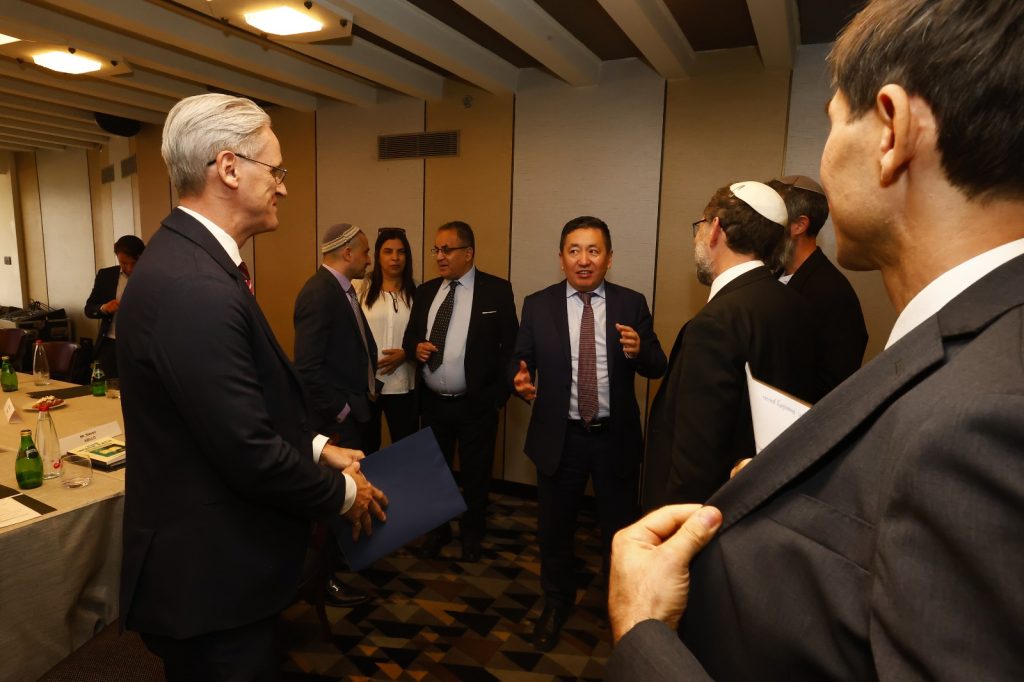
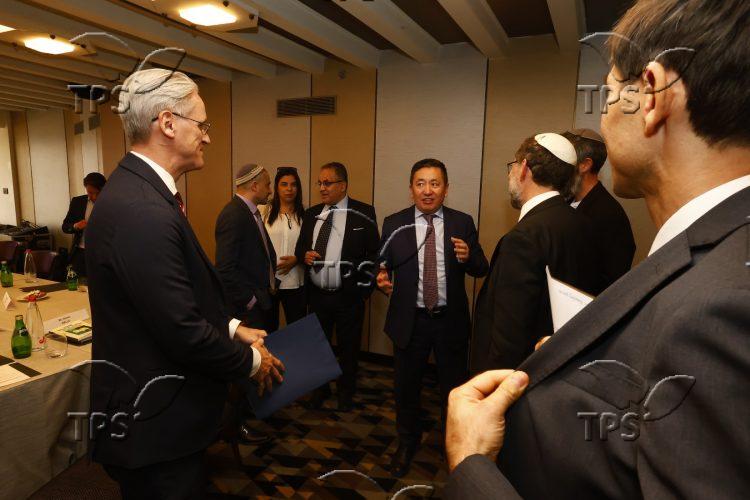
Kazakh Ambassador to Israel Daulet Yemberdiyev (center) greets attendees at an interfaith gathering in Tel Aviv on Nov. 16, 2026. Photo by Eitan Elhadez-Barak/TPS-IL
Organized by the International Center for Interreligious Dialogue in Astana, with support from Kazakhstan’s Embassy in Israel, the event followed an October gathering of the Secretariat of the Congress of Leaders of World and Traditional Religions in the Kazakh capital.
Kazakhstan’s Ambassador to Israel, Daulet Yemberdiyev, said the October meeting had marked a shift toward practical cooperation, with participants adopting documents addressing artificial intelligence, climate change and the rights of children suffering from incurable illnesses.
“What we are all doing together here today is truly unique—we are taking our first steps toward moving from dialogue to action,” Yemberdiyev said.
He proposed promoting the documents through educational initiatives in Israel, while supporting Kazakh President Kassym-Jomart Tokayev’s proposal to establish a global peace movement.
Gulsana Kozhabay, chair of the board of the International Center for Interreligious Dialogue, said Kazakhstan’s accession to the Abraham Accords in November 2025 had created additional opportunities for cooperation.
“Dialogue alone is not enough—we must translate mutual understanding into practical cooperation,” she said.
Building Bridges Across Faiths
Imam Nurlan Asanov of the Spiritual Administration of Muslims of Kazakhstan said the country’s Silk Road history had helped shape a tradition of welcoming people of different faiths.
“Muslims constitute the absolute majority in Kazakhstan; however, for us, being the majority is not a privilege, but rather a tremendous responsibility toward our brothers and sisters of other faiths,” he said.
Bishop Piotr Pytlovany of Karaganda compared the country’s religious diversity to the dombra, Kazakhstan’s traditional string instrument, whose different strings combine to create harmony. He advocated “dialogue through service,” including volunteering to assist the elderly and sick.
Rabbi Dr. Yaakov Nagen, president of the Jerusalem Center for Interreligious Dialogue, argued that the concept of tolerance falls short of genuine interfaith understanding because it suggests simply putting up with people whose beliefs differ from one’s own.
“When tensions rise, this approach collapses,” Nagen said. “The solution lies in transforming religious identity from a barrier into a bridge—moving beyond mere coexistence toward ‘co-elevation’ and fraternity.”
Nagen concluded by quoting a passage from the Quran calling on believers to remain united. The gesture prompted Yemberdiyev to respond: “May our religious identity unite us rather than divide us—Inshallah, and with God’s help!”
Participants also addressed the war in the Middle East. Dr. Khaled Khalifa, CEO of the Arab Council for Foreign Relations in Nazareth, said religious leaders must confront the gap between political rhetoric and reality.
“This country has been suffering from war for three years now; we must consider how to halt this conflict and foster dialogue and peace between Palestinians and Israelis,” he said.
Other speakers warned against using religious texts to justify violence and called for dialogue within religious communities to challenge extremism. They also highlighted the importance of human connections amid growing reliance on artificial intelligence.
Dr. David Rutstein, secretary-general of the Bahá’í International Community, described the effort as “spiritual diplomacy,” emphasizing trust, education and gender equality as foundations for lasting peace.
Yemberdiyev closed with an appeal to participants: “Please do not give up. Let us move forward and carry this light of love and tolerance onto the ground of shared reason.”
The ambassador also recalled lighting a Chanukah candle in Israel, saying: “I always say that I am part Jewish, part Muslim, and part Christian—we are all under one God.”