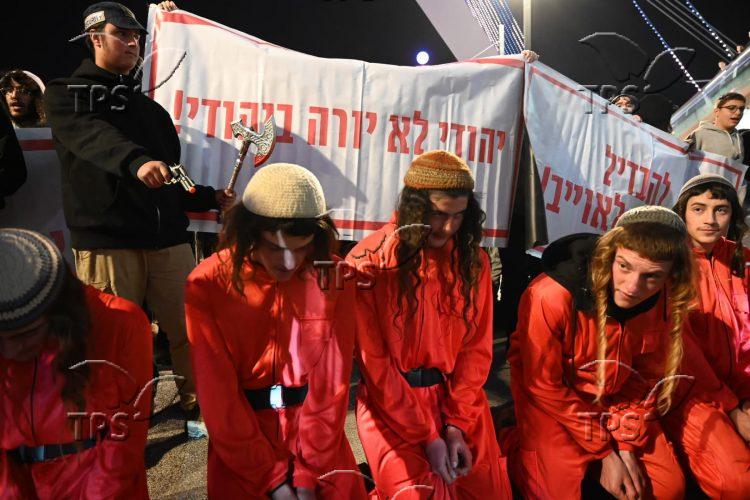
Photo by
Yoav Dudkevitch/TPS-IL on 9 April, 2025
‘Cracking That Trust’: Public Confidence in Israeli Security Agency Plunges
Jerusalem, 9 April, 2025 (TPS-IL) -- Public confidence in the Israel Security Agency, better known as the Shin Bet, has plunged over the past week. The High Court of Justice heard petitions against the government’s dismissal of director Ronen Bar on Wednesday, while on Sunday, an explosive recording was aired on TV in which a senior security figure admitted that Jews from Judea and Samaria are often detained without evidence. One legal expert told The Press Service of Israel that the agency has been targeting residents based on their ideology.
Both stories have drawn public criticism and attention to an agency that prefers to stay out of the spotlight.
In the recording, which was aired on the Kan public broadcaster the head of the Shin Bet’s Division for Counterterrorism in the Non-Arab Sector, identified as A., called Jewish terror suspects from Judea and Samaria “scumbags” and said the agency often arrested Jewish suspects without evidence and “put them in detention cells, with rats.”
Speaking to Avishai Mualem, a senior officer in the Israeli Police’s Judea and Samaria Division. A. said, “We’ve been through this before, we’ll detain them even without evidence.”
The recording has opened the Shin Bet to accusations that it disproportionately targets residents of Judea and Samaria and individuals affiliated with the political right.
Attorney Nati Rom, of the legal aid organization Honenu who represents several Jewish detainees from Judea and Samaria, told The Press Service of Israel he was not surprised by the content of the recordings.
“These are tools that a democracy gives the Shin Bet — extraordinary powers to protect the state’s security,” Rom said. “But they are supposed to be used in extreme, exceptional cases. What we’re seeing is that these tools are being used ideologically, against residents of specific areas, and with hostility toward them.”
Rom added that despite the division’s stated mission to address domestic threats broadly, in practice “they focus only on Judea and Samaria.”
Rom recalled one particularly revealing exchange with a Shin Bet figure.
“I once asked a Shin Bet person — someone with ten years of experience — whether he could recall a single case where these tools were used against someone who wasn’t on the political right. He told me, ‘No, I can’t remember such a case.’”
Rom described the physical and emotional toll of detention.
“It’s very, very sad to see. They are being held in a cell with scribbled walls and metal benches, essentially in solitary confinement. These conditions — they echo exactly what we heard in the recordings,” Rom told TPS-IL.
He stressed that the detainees in question are often deeply committed to the state of Israel.
“Some of them are soldiers. Some are local security officials. They’ve been serving the country and working non-stop since October 7 — for hundreds of days. These are good people, loyal to the land and the people. And yet, the Shin Bet seems incapable of distinguishing between friend and enemy.”
He added, “These are people who once had a great faith in the system — people willing to risk their lives for it. But what’s happening now… it’s cracking that trust more and more.”
The public response to the leak has been swift and harsh. Just days before the broadcast of the tapes, the Shin Bet posted on its official Facebook page a rare recruitment announcement for a variety of operational roles. What followed was a once-unthinkable barrage of critical comments from Israelis.
“Give the keys to the Mossad — the public has no trust in you anymore,” wrote one user.
“Do you work against enemies of the state — or against the people of Israel?” asked another one.
Other people questioned whether “right-wingers” were even accepted into the Shin Bet” or called on the government to “purge the leadership and start from scratch.”
Others said the Shin Bet is due for a shakeup following its failure to anticipate Hamas’ October 7 attack.
“For years I considered this agency top of the top — in human capital, in intelligence, in technology. But what we saw on October 7, and what’s emerging now — it’s heartbreaking,” one person said.
Prime Minister Benjamin Netanyahu and Bar have been blaming each other over what was known before Hamas’ October 7 attack and whether it could have been prevented, as well as the “Qatargate” scandal. The government voted to fire Bar in March, but the High Court of Justice on Tuesday issued an interim injunction against his dismissal.
That hearing was disrupted by bereaved parents who were angered to learn that Bar was not in attendance.
Bar claims that Netanyahu’s decision to dismiss him was influenced by a conflict of interest related to the ongoing investigation. The government argues that Bar should have resigned after the agency completed its internal investigation in March.
The Shin Bet, Israel’s domestic intelligence service, is responsible for counterterrorism, counterintelligence, internal security, VIP protection, and cybersecurity. The only Shin Bet director to ever leave before the end of his five-year term was Carmi Gillon, who resigned in the aftermath of the 1995 assassination of Prime Minister Yitzhak Rabin.