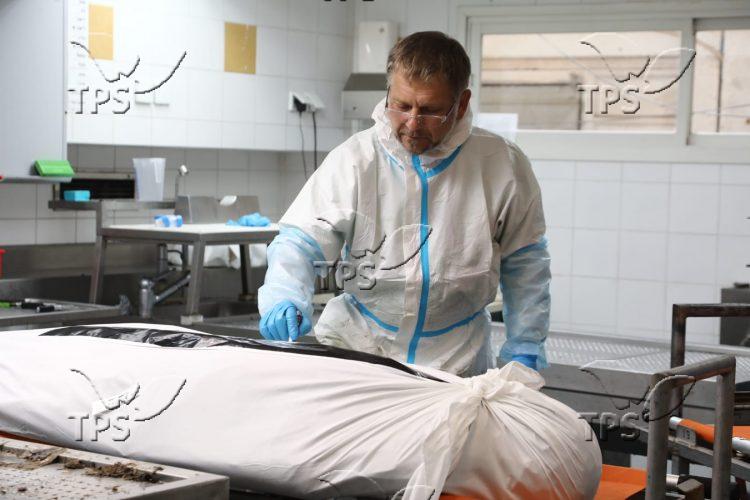
Photo by
Gideon Markowicz/TPS on 16 October, 2023
Deceased Hostages May Never Be Identified as Forensic Window Closes, Report Warns
Jerusalem, 29 April, 2025 (TPS-IL) -- The remains of 35 deceased hostages in Gaza might never be identified as a window for forensic investigation rapidly closes, a report released on Tuesday warned.
Authored by public health and forensic experts on the Health Team of the Hostages and Missing Families Forum, the report noted a range of threats to the preservation of remains.
“Without the return of the fallen hostages and in the absence of certainty, the families become the living-dead, and the fallen remain the dead-alive,” said Prof. Hagai Levine, Head of the Health Team of the Hostages and Missing Families Forum. “This wound undermines the very trust upon which the social fabric relies.” Co-authors were Dr. Einat Yehene and Dr. Amir Blumenfeld.
High heat, flooding, sewage exposure, building collapses, and animal interference are accelerating the decomposition of bodies, the report said. This degradation directly obstructs the ability to conduct pathological examinations, identify remains, and gather evidence about the cause of death or potential war crimes.
The situation is worsened by the belief that many of the deceased are being held in Hamas’s underground tunnel network, where harsh physical conditions prevail — high humidity, poor ventilation, and the constant risk of collapse. Damage to these tunnels from bombings, sabotage, or ground movement threaten to disperse or destroy the remains. Even if the tunnels are located later, critical forensic damage could be irreversible.
“The longer the remains lie unrecovered, the greater the loss of vital forensic evidence,” the report warned. “Pathological examinations may no longer be possible. Signs of trauma, abuse, or execution may be erased. DNA may degrade beyond analysis. Legal accountability may vanish.”
Most notably, an examination of the remains returned by Hamas in February found that the DNA did not match that of Shiri Bibas or any other Israeli hostages. The following day, Hamas returned a body, which Israel’s National Institute of Forensic Medicine confirmed was the 32-year-old mother of two.
Further analysis of the remains of Shiri and her sons — four-year-old Ariel and nine-month-old Kfir — determined that they were murdered, and had not died in an explosion as Hamas claimed.
The paper also raised concerns that the whereabouts of many of the deceased hostages are known only to a few individuals who may die or disappear during fighting, without leaving any documented record. As time passes, the intelligence gap deepens, and the possibility of obtaining direct, reliable information to guide recovery efforts diminishes.
Beyond the technical forensic implications, the report noted the emotional toll on the families of the fallen. These families are left in a state of unresolved grief, suffering from what the report described as “ambiguous loss” — an emotional state where the absence of remains denies closure and prolongs trauma.
The Forum released its report on the eve of Israel’s Memorial Day, which begins at sundown on Tuesday. As of Memorial Day, the hostages will have been held in Gaza for 569 days, the Forum noted.
At least 1,180 people were killed, and 252 Israelis and foreigners were taken hostage in Hamas’s attacks on Israeli communities near the Gaza border on October 7. Of the 59 remaining hostages, 35 are believed to be dead.