Photo by
Majdi Fathi/TPS-IL on 15 September, 2024
Inside Hamas’s Aid Racket: Black Markets, Secret Cash Transfers, and Smuggling Rings
Jerusalem, 12 June, 2025 (TPS-IL) -- The Israel Defense Forces on Thursday released Hamas documents and recordings exposing the terror group’s strategy to exploit humanitarian aid. These declassified materials reveal how Hamas not only hijacked the flow of aid but systematically manipulated it to strengthen its military infrastructure.
“Hamas diverted significant portions of the aid to serve its own interests,” the IDF stated. “This was done at the expense of the civilian population in Gaza, whom Hamas has consistently exploited for its own survival.”
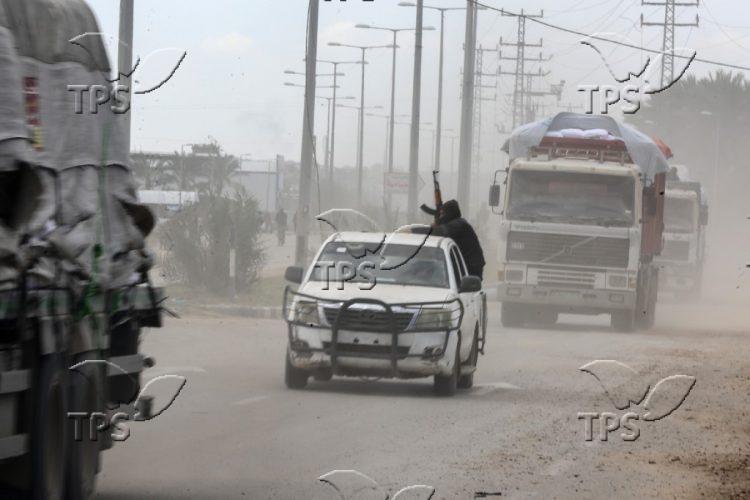
According to the IDF, Hamas viewed the influx of humanitarian assistance not as a lifeline for civilians, but as an opportunity to enrich its operations and tighten its grip on the Gaza Strip. Intelligence documents now declassified indicate that Hamas openly and covertly embedded operatives within incoming aid convoys, positioning itself as the central authority overseeing distribution in much of the enclave.
One of the primary methods outlined involved a systematic boycott mechanism whereby between 15-25% of incoming aid was automatically seized by Hamas.
“This diverted aid was either handed directly to Hamas operatives or sold at inflated prices on the black market,” the military revealed. A newly uncovered internal Hamas document confirmed that percentages of seizure were adjusted during the war based on shifting logistical needs.
Another scheme involved the smuggling and monopolization of prohibited goods, particularly cigarettes. Hamas reportedly banned private merchants from selling tobacco products, while simultaneously orchestrating efforts to smuggle and distribute the same goods at exorbitant rates. The Israeli Defense Ministry border inspectors thwarted dozens of such smuggling attempts throughout the war.
“Hamas turned even basic consumer goods into tools of control and profit,” a senior IDF intelligence officer said. “They prevented local traders from operating freely, while cornering the market for themselves.”
Beyond material aid, Hamas exploited foreign funding through a financial mechanism known as hawala. This refers to an informal network of trusted brokers to transfer money rather than through traditional banking systems. Hawala typically leaves little to no paper trail. According to IDF estimates, Hamas received hundreds of millions of shekels via operatives abroad, primarily through intermediaries based in Turkey. This money was then used to purchase surplus aid, which was brought into Gaza and sold at inflated prices — again, turning humanitarian goods into a cash-generating venture.
The IDF also highlighted the terrorist organization’s use of mafia-style extortion. Under what officials described as a “protection” racket, Hamas imposed taxes and security fees on various sectors in Gaza, further consolidating control and extracting profit.
“This is not just theft—it’s systemic abuse of international goodwill,” the IDF said in a statement. “Hamas has earned hundreds of millions of dollars in cash and goods through its exploitation of aid meant for civilians.”
The Press Service of Israel reported in November that Hamas and criminal gangs associated with it hijacked 85% of all the trucks entering the Strip with food, water, medicine and other humanitarian items. TPS-IL learned that Hamas granted distribution lines to these groups to ensure that humanitarian aid exclusively reaches Hamas. In return, these gangs receive money, food and vouchers. Hamas also pays these gangs $10,000 a month to maintain checkpoints.
The impact of these schemes became particularly evident after the Israeli government ordered a halt to the entry of humanitarian aid in early March. According to the military, this move sharply curtailed Hamas’s revenue stream, resulting in significant financial distress. “They were forced to reduce or even stop paying salaries to some of their members,” the IDF disclosed.
In response to the abuse, the IDF, in coordination with Military Intelligence and the Defense Intelligence Agency, has implemented new oversight procedures to ensure aid does not fall into Hamas hands. These include detailed registration of aid organizations, enhanced customs and inspection protocols at crossings, and sanctions for non-compliance.
More recently, the resumption of aid delivery through distribution centers operated by international organizations—now under civilian security supervision—has created a system that bypasses Hamas entirely. “Food packages are being delivered directly to Gaza residents,” the IDF said, “without Hamas interference.”
On Wednesday night, Hamas attacked an aid convoy belonging to the Gaza Humanitarian Foundation, killing eight aid workers and kidnapping several others. Hamas has also fired on Palestinians making their way to distribution centers. Residents of the Strip accuse the terror group of violence to deliberately disrupt the aid.
“The evidence is overwhelming,” the military concluded. “Hamas is not interested in the welfare of Gaza’s residents. Its only concern is maintaining power and attacking Israeli civilians. The world must recognize this cynical exploitation for what it is.”
At least 1,180 people were killed, and 252 Israelis and foreigners were taken hostage in Hamas’s attacks on Israeli communities near the Gaza border on October 7. Of the 53 remaining hostages, around 30 are believed to be dead.