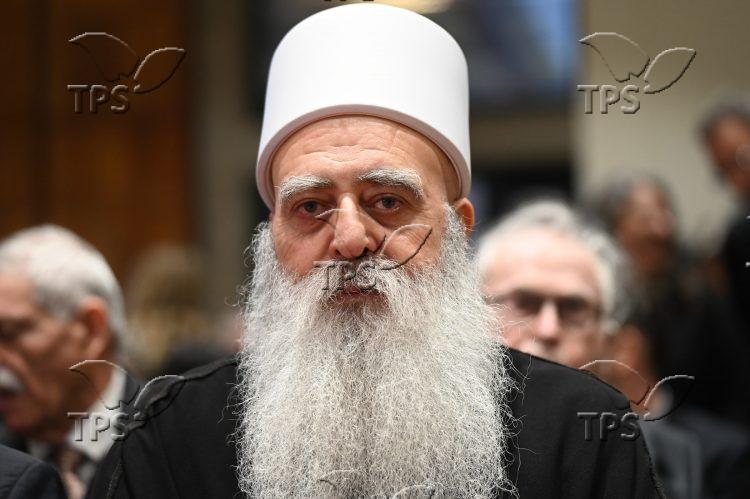
Photo by
Yoav Dudkevitch/TPS-IL on 13 February, 2025
‘Return Them to the Villages’: Israeli Druze Leader Pleads for Humanitarian Access to Suweida
Jerusalem, 19 February, 2026 (TPS-IL) -- More than 120,000 Druze remain displaced from their villages in southern Syria’s Suweida region, cut off from food, medicine and humanitarian aid as winter deepens. Experts and Druze leaders told The Press Service of Israel that the situation risks escalating into a recurring cycle of massacres against one of the Middle East’s most distinct communities if the world doesn’t step up protection and assistance.
Sheikh Mowafaq Tarif, the spiritual leader of Israel’s 152,000-strong Druze community and one of the country’s most respected minority figures, is unsparing in his assessment of the international response. He is preoccupied with coordinating donations and supplies through a humanitarian aid unit established in the Israeli Druze village of Julis, but says the effort falls far short of what is needed.
“We transfer, but it is very little, very little,” Tarif told TPS-IL. “Today, 800 trucks of humanitarian aid are brought into Gaza every day. All the international organizations that provide aid, and the hypocrisy of the world.”
In July, more than 3,500 Druze were killed when ethnic violence broke out between local Druze and Bedouins. Syrian forces loyal to President Ahmed al-Sharaa fought with the Bedouins, prompting Israeli airstrikes. Sharaa’s forces continue to besiege Suweida and an estimated 120,000 Druze are still displaced, and there have been steady reports of kidnappings and sexual violence against the Druze.
The sheikh has met with international officials who he says acknowledge the scale of the crisis but deflect responsibility. When Druze activists pushed for Suweida to be declared a disaster area, Tarif was told that the declaration must come from the Syrian government.
“Dear God, how will the government declare this area a disaster area?” Tarif said. “It’s the one surrounding them.”
Of Syria’s 38 Druze villages in the Suweida area, 30 are currently off-limits to their former residents, who fled with almost nothing. Those who remain face a blockade that bars the entry of food, medicine and other essentials.
As a result, the aid reaching Suweida is the result of grassroots Israeli Druze efforts with Jerusalem’s assistance.
Prime Minister Benjamin Netanyahu has called for the demilitarization of southern Syria, prompting one Syrian Druze man to tell TPS-IL that “Israel is the Iron Dome of the Druze in Syria.”
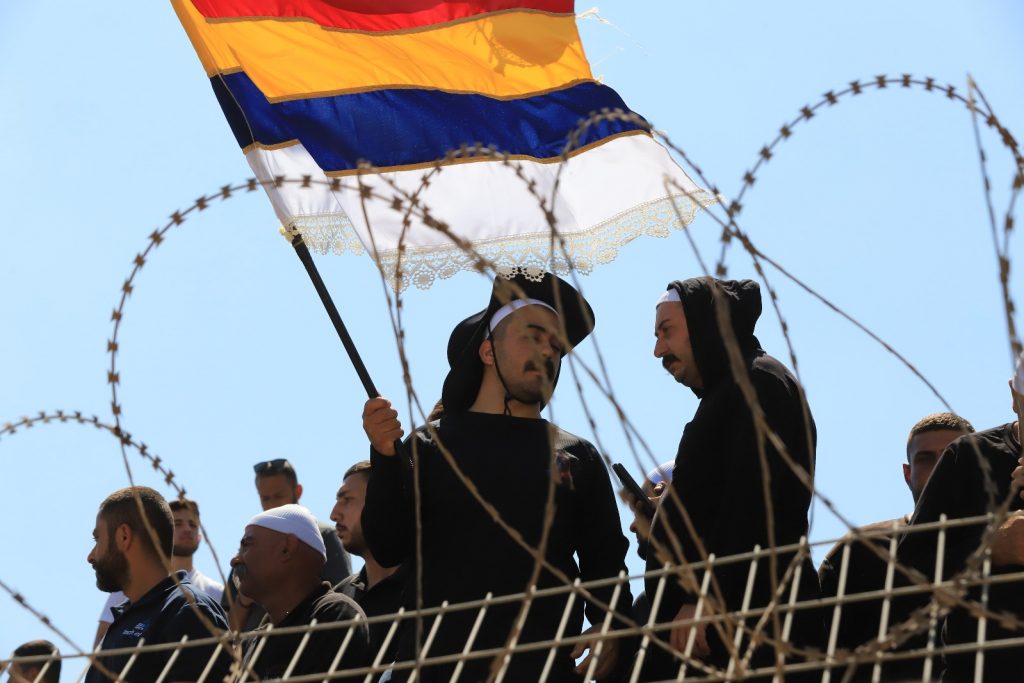
Israel Druze in the Golan Heights mass along the Syrian border on July 16, 2025 in a bid to help their Syrian brethren, who have been locked in days of ethnic violence against Bedouins and the Syrian army. Photo by Eitan Elhadez-Barak/TPS-IL
Fragile Lifeline
Professor Eyal Zisser, chair of Tel Aviv University’s Department of Middle Eastern and African History, explained that that Israel has become the primary external lifeline for the Syrian Druze, providing indirect humanitarian assistance through airdrops, Jordan and third-party intermediaries, while stopping short of establishing a land corridor.
“They cannot survive for long without us,” Zisser told TPS-IL. “Jordan will not help them directly because it is worried about its relations with the Syrian regime.”
Suweida’s mountainous terrain will help the Druze defend themselves somewhat, “but maintaining autonomy over time is only possible through Israeli support,” Zisser added.
The Druze trace their ancestry back to the Biblical figure Jethro, the father-in-law of Moses. They speak Arabic but are not Muslim.
Israeli analyst and commentator Gal Gideon Ben Avraham explained that Syria’s new armed forces are centered on Hayat Tahrir al-Sham, the Islamist rebel group led by al-Sharaa himself and backed by Turkey. The army consists of roughly 200,000 men alongside some 50 allied militias united by an Islamist ideology that views the Druze as heretics.
“For them, the Druze are sentenced to death according to the Quran,” Ben Avraham told TPS-IL.
The Druze of Suweida are currently led by Hikmat al-Hajri and his Druze National Guard, which have pivoted toward cooperation with Israel. But Ben Avraham cautioned that the alliance is fragile. U.S. President Donald Trump supports a unified Syria under al-Sharaa and has pushed back against Israeli military action in the country. “It all depends on the relationship between Trump and [Netanyahu],” Ben Avraham said.
Israel sent forces into the 235 sq km buffer zone on the Syrian border to prevent Islamist rebels from approaching the regime of Bashar Assad collapsed in December 2024. Jerusalem considers the 1974 ceasefire agreement void until order is restored in Syria.
For Tarif, the politics are secondary to the human emergency. He called on the world to allow humanitarian access, secure the return of displaced families to their villages and obtain the release of those still held captive. “First we need the situation to improve,” he said. “Return them to the villages, return the kidnapped, let humanitarian aid in.”