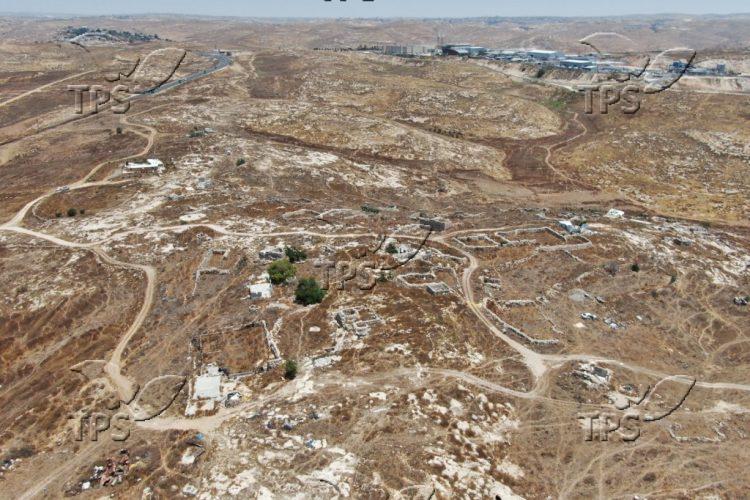
Photo by
Eytan Shalem/TPS-IL on 13 July, 2026
New Details Raise Questions Over Ro Khanna’s Provocative Breaking the Silence Trip in Judea and Samaria
Jerusalem, 13 July, 2026 (TPS-IL) -- Editor’s note: This story has been updated to reflect that the Khribet Zanuta’s status as a closed military zone had expired.
U.S. Congressman Ro Khanna’s visit to Israel sparked international attention after he accused Israeli civilians and soldiers of detaining his delegation in the South Hebron Hills. But a TPS-IL investigation found that the group traveled without coordination to an area known as a closed military zone, and that the delegation’s tour guide had been previously warned against entering this restricted area.
Khanna, a California Democrat who has said he is considering running for president in the 2028 elections, declined meetings with Israeli officials and communities offered as part of the trip, prompting criticism from some Israelis who characterized the visit as “looking for a headline.”
Khirbet Zanuta is an archaeological site dating back to the Hasmonean Period located in Area C of Judea and Samaria, where Israel retains administrative and security authority under the Oslo Accords. In response to illegal Palestinian construction there, the Israeli Civil Administration — the military body responsible for overseeing many governmental functions in Judea and Samaria — designated Khirbet Zanuta a closed military zone in February 2025.
Editor’s note: This designation expired at the beginning of 2026. However, responding soldiers and police officers were not aware of this.
To reconstruct the events of the July 8 incident, TPS-IL visited Khirbet Zanuta, interviewed eyewitnesses and an Israeli government source familiar with Khanna’s visit, and reviewed video footage.
According to social media posts by Khanna and Breaking the Silence, the delegation was “detained” by what they described as “Israeli settlers.”
“Israeli settlers, brandishing American made M4s, detained me & other Americans on my trip to Palestine,” Khanna tweeted on Saturday.
“Armed settlers were the first to arrive, and then, as has become the norm, Israeli soldiers joined them. Together they detained the delegation for over an hour,” tweeted the tour guide, Nadav Weiman, who is executive director of Breaking the Silence. Breaking the Silence is an Israeli non-profit that publishes soldiers’ testimonies critical of Israel’s policies in Judea and Samaria.
Khanna said armed men surrounded the group’s van, blocked the road, cursed members of the delegation and kicked the vehicle’s tires. He also accused Israeli soldiers who arrived at the scene of siding with the settlers and continuing the group’s detention.
TPS-IL’s investigation found that Israeli civilian security personnel blocked the delegation’s vehicles before soldiers arrived and dispersed them. However, police said officers who reached the scene witnessed no violence.
Police and local security personnel also said Weiman had previously violated the closed military zone order and had been warned about entering the area.
Editor’s note: According to the police report, soldiers told the officers the vehicles had entered a closed military zone. The police deferred questions of Khribet Zanuta’s status to the Israel Defense Forces’ Spokesperson’s Unit.
No Advance Coordination
An Israeli security official told TPS-IL that Khanna’s delegation did not coordinate its arrival in advance.
“They did not coordinate the visit,” the official said. “Usually, advance notice is received.”
According to the official, visits by foreign lawmakers and other prominent delegations to sensitive areas of Judea and Samaria are generally coordinated with Israeli authorities. Such coordination allows authorities to assess access restrictions, security conditions and logistical arrangements.
The official said Israeli civilian security personnel arrived and blocked the delegation before troops intervened.
“Settlers arrived, blocked them, the army dispersed them, and that was basically the end of the incident,” the official said.
The source added that security forces sought to resolve the obstruction quickly after learning that the vehicles had been blocked.
Tour Guide Had Been Warned
According to Israeli Police, Wednesday’s incident was not the first time Weiman had entered the closed area.
Police said a review of officers’ body-camera footage showed that the group leader referred to Weiman’s previous violations of the same closed military zone order.
“He was issued a final warning that any future violations would result in immediate arrest,” police said in a statement to TPS-IL.
Police did not specify when the previous incidents occurred or how many earlier warnings had been issued.
A local reservist who serves on a civilian security team and was present during Wednesday’s confrontation told TPS-IL that Weiman had visited the area repeatedly despite being told it was closed.
“I know the location and know it is a closed military zone,” he said. “This is not the first time I have called the army, security forces or police about vehicles inside the area.”
He recalled receiving a call reporting two vehicles in Khirbet Zanuta. He said he went to the site and contacted the army and police.
The guard told TPS-IL he recognized Weiman among the visitors.
“He has come here dozens of times,” the reservist said. “The police have warned him several times and made clear that this is a closed military zone.”
According to the reservist, the vehicles began moving as he approached. He said he told the occupants that the army and police had been called and asked them to remain while authorities examined their entry into the zone.
“They said, ‘No problem, we will wait for the army and police,’” he recalled.
The reservist denied threatening or attacking anyone, and said he did not know a Congressman was traveling with the group.
“The focus was on Nadav Weiman,” he insisted.
The reservist said soldiers arrived 10-20 minutes later, and he departed, leaving the matter to them.
Another local eyewitness, Elkana, told TPS-IL that two reservists approached the group’s security guard and explained that the delegation was inside a closed military zone. Elkana denied that anyone assaulted the visitors. He did confirm that some locals obstructed the visitors before being dispersed by arriving soldiers.
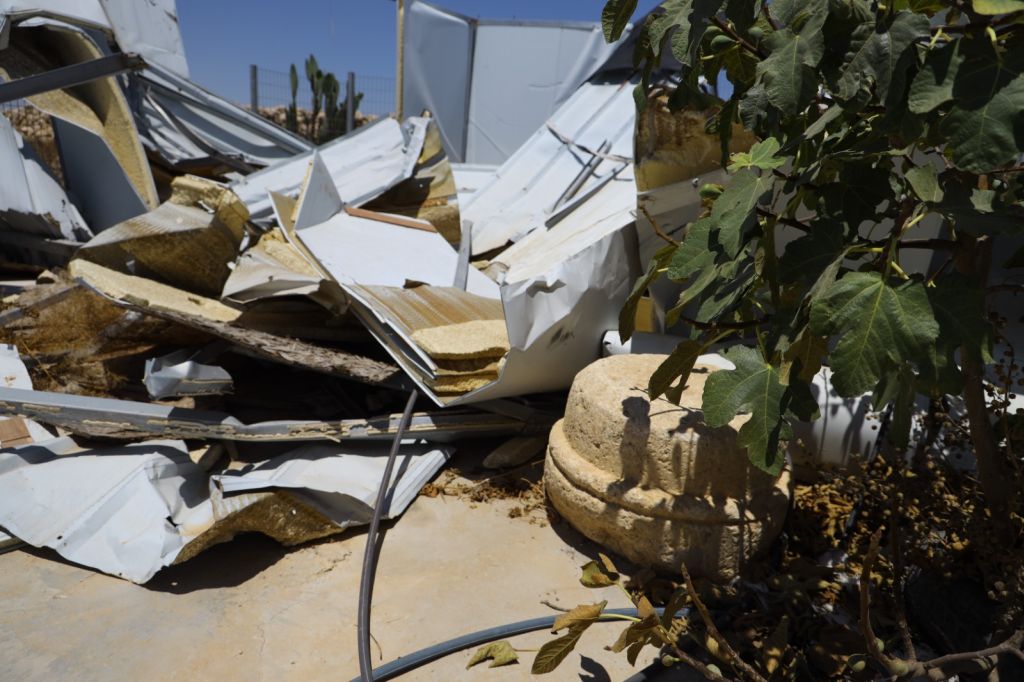
The remains of an illegal Palestinian structure in Khribet Zanuta, an archaeological site in the South Hebron HIlls on July 12, 2026. Photo by Eytan Shalem/TPS-IL
No Violence
Police records reviewed by TPS-IL show that the initial report of “a group of individuals blocking a route” was first received at approximately 5:00 P.M. Officers arrived about 30 minutes later, with soldiers already on the scene. The police report only described what officers observed after arriving and does not establish what occurred before they reached Khirbet Zanuta.
“Upon arrival, police officers joined IDF forces already on the scene. The officers were informed by the soldiers present that the tour group had entered a designated Closed Military Zone,” the police report seen by TPS-IL said.
Police said responsibility for the initial security response belonged to the IDF because the location was under military jurisdiction.
“Responding officers witnessed no violence on scene,” the statement said.
Police said officers instead addressed the conduct of the tour organizers and informed participants about the military order. The group was then allowed to leave.
TPS-IL was unable to independently verify Khanna’s allegations that people kicked the vehicle’s tires, cursed the passengers or used their rifles to threaten members of the group.
Photographs and video published after the incident show armed Israelis near the delegation’s vehicles. The images do not show weapons being pointed at the passengers.
Israeli Source Criticizes Khanna’s Visit
An Israeli government source familiar with the contacts surrounding Khanna’s trip said officials offered to arrange meetings with Druze communities in the Golan Heights, representatives of Israeli border communities and officials involved in transferring humanitarian assistance into Gaza.
“Congressman Khanna didn’t come to understand the situation – he came looking for a headline,” the source told TPS-IL.
“Israel went out of its way to provide Congressman Khanna with access to communities that reflected the complexity of the situation. He chose a different path” and did not take up the offers, the source said.
TPS-IL has not independently reviewed correspondence between Israeli officials and Khanna’s office and could not determine why the proposed meetings did not take place.
Khanna has said his itinerary was intended to provide an unfiltered view of what he described as the human cost of Israeli control in Judea and Samaria.
Khanna’s office and Breaking the Silence did not respond to TPS-IL queries about whether the tour organizers knew Khirbet Zanuta was a restricted area, whether they sought advance coordination with Israeli authorities, and whether Weiman had received previous police warnings.