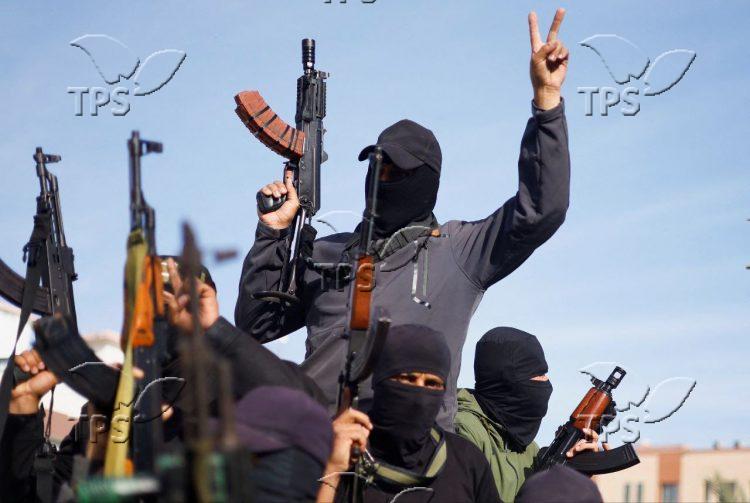
Photo by
Majdi Fathi/TPS-IL on 19 January, 2025
Hamas Will Rebrand Itself as Gaza’s ‘Provider’ as Experts Sound Warning on Humanitarian Aid
Jerusalem, 19 January, 2025 (TPS-IL) -- As Israel readied for the release of three hostages on Sunday in a controversial ceasefire agreement, experts warned The Press Service of Israel that the truce does not adequately address the problem of Hamas seizing increased deliveries of humanitarian aid.
“We’re talking about the daily transfer of around 600 trucks of humanitarian aid,” Maurice Hirsch, a legal expert and former military prosecutor told TPS-IL.
He said the agreement is fundamentally flawed, saying terrorists will “reintegrate into Hamas’ hierarchical command system,” undoing years of Israeli counterterrorism efforts.
Hamas control over aid will enable the terror group to “rebrand itself as a provider for the Gazan population while filling its coffers and rebuilding its military capabilities,” Hirsch said.
The Tzav 9 movement, which has long opposed the transfer of humanitarian aid to Hamas-controlled areas ever since the war started, criticized the agreement.
“If Hamas militants had to beg for food and water, we would have secured the release of all hostages long ago,” a Tzav 9 spokesperson told TPS-IL, arguing that the trucks supplying aid to Gaza serve as a lifeline for Hamas, allowing the organization to “recruit new militants, sustain itself, and continue its reign of terror.”
The movement demands a comprehensive strategy to ensure humanitarian aid bypasses Hamas entirely, insisting that “strengthening terror is not an acceptable price for the return of our loved ones.”
Col. (Res.) Hezi Nechama, a reserve brigade commander and one of the founders of the Forum of Reservist Commanders and Fighters, warned TPS-IL that facilitating Gaza’s reconstruction under the current circumstances will inevitably bolster Hamas.
“The funds required to rebuild Gaza are astronomical,” Nechama said. “Anyone who believes they can control how this money is allocated is deluding themselves.” He predicted that reconstruction materials, such as cement and steel would be diverted to rebuild Hamas’ military infrastructure, including tunnels and weapons.
A representative of the Prime Minister’s Office recently responded to a query from TPS-IL regarding the rationale behind providing humanitarian aid to Gaza, given that the terrorist organization Hamas exploits civilian infrastructure to strengthen its power and carry out attacks.
“Hamas has cynically used civilian and medical infrastructure for terror activities, including at the Kamal Adwan Hospital, where IDF forces recently arrested 240 terrorists,” David Mencer, a spokesman for the National Public Diplomacy Directorate in the Office of the Prime Minister told TPS-IL. “Despite this, we have a duty to provide aid to Gazan civilians, not terrorists, and we are taking every precaution to ensure this.”
Mencer acknowledged the challenges posed by Hamas’ theft of aid, which is often resold at exorbitant prices to Gaza’s residents.
“This underscores the urgent need to eradicate Hamas and remove them from any governing role in Gaza’s future,” Mencer said. “The government’s ultimate goal remains clear: “Freeing Gaza from Hamas.”
Since mid-November, Hamas and criminal gangs associated with the terror group stepped up their stealing of deliveries of food, water, medicine and other humanitarian supplies. At one point, 85% of all trucks entering the Strip were hijacked.
The Press Service of Israel has learned that Hamas has granted distribution lines to these groups to ensure that humanitarian aid exclusively reaches Hamas. In return, these gangs receive money, food and vouchers. Hamas also pays these gangs $10,000 a month to maintain checkpoints.
Meanwhile, sacks of flour and rice donated by the West are being sold for $700 and $500 respectively while a pack of cigarettes costs $1,500. In September, Palestinian sources told TPS-IL that Hamas was charging $800 for donated tents.
The first phase of the ceasefire will see 33 Israeli hostages freed over several days in exchange for hundreds of Palestinian terrorists imprisoned in Israel. The exact number will depend on how many of the 33 hostages are alive.
At least 1,200 people were killed, and 252 Israelis and foreigners were taken hostage in Hamas’s attacks on Israeli communities near the Gaza border on October 7. Of the 95 remaining hostages, more than 30 have been declared dead.